

Introduction
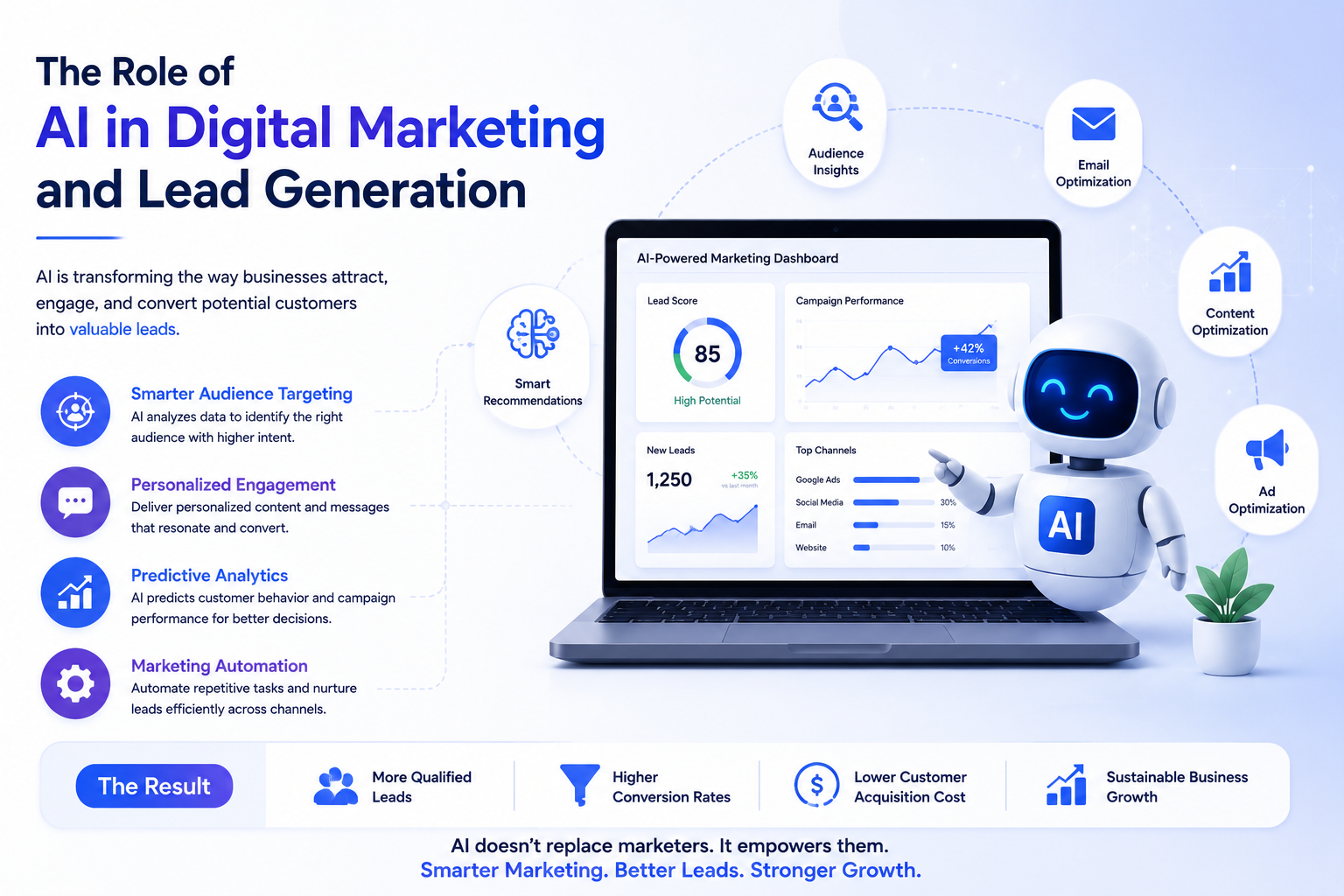
Artificial Intelligence (AI) is rapidly transforming the way businesses approach digital marketing and lead generation. What once required extensive manual effort, large marketing teams, and significant budgets can now be automated, optimized, and scaled through intelligent AI-powered solutions. From personalized customer experiences and predictive analytics to automated content creation and lead nurturing, AI has become one of the most powerful tools available to modern marketers.
As competition continues to increase across industries, businesses are looking for smarter ways to attract potential customers, improve marketing efficiency, and generate high-quality leads. AI helps organizations achieve these goals by analyzing large amounts of data, identifying customer behavior patterns, and automating repetitive marketing tasks.
Today, businesses of all sizes are using AI to improve campaign performance, increase conversion rates, and make better marketing decisions. Understanding the role of AI in digital marketing and lead generation is essential for companies that want to remain competitive and achieve sustainable growth.
Understanding AI in Digital Marketing
Artificial Intelligence refers to technologies that enable machines to perform tasks that typically require human intelligence. These tasks include learning from data, recognizing patterns, making predictions, understanding language, and automating decision-making processes.
In digital marketing, AI helps businesses analyze customer behavior, optimize advertising campaigns, personalize content, automate communication, and improve overall marketing effectiveness.
Rather than replacing marketers, AI acts as a powerful assistant that helps marketing teams work more efficiently and make data-driven decisions.
As AI technology continues to evolve, its impact on digital marketing becomes increasingly significant.
How AI is Transforming Digital Marketing
Traditional digital marketing often relies on manual analysis, assumptions, and broad audience targeting. AI changes this approach by enabling marketers to understand customers at a much deeper level.
AI-powered systems can process vast amounts of customer data in real time, identify patterns, and generate insights that would be difficult for humans to uncover manually.
This allows businesses to create highly targeted campaigns, deliver personalized experiences, and optimize marketing strategies based on actual customer behavior rather than guesswork.
The result is improved efficiency, stronger engagement, and better marketing outcomes.
Personalized Customer Experiences
Personalization has become one of the most important factors in successful digital marketing.
Modern customers expect brands to understand their preferences and provide relevant experiences. Generic marketing messages often fail to capture attention, while personalized content creates stronger connections.
AI helps businesses deliver personalized experiences by analyzing customer behavior, browsing history, purchase patterns, and engagement data.
Using these insights, businesses can recommend products, customize email campaigns, personalize website content, and deliver targeted advertisements.
Personalized marketing improves customer satisfaction and significantly increases the likelihood of conversions.
AI-Powered Content Creation
Content remains at the heart of digital marketing, but creating high-quality content consistently can be time-consuming.
AI-powered tools help businesses generate blog ideas, write marketing copy, create social media content, optimize headlines, and improve content strategies.
While human creativity remains essential, AI can streamline the content creation process and improve productivity.
Businesses can use AI to identify trending topics, discover content opportunities, and ensure their messaging aligns with audience interests.
This enables marketing teams to produce more content while maintaining quality and relevance.
Smarter Audience Targeting
One of the biggest challenges in digital marketing is reaching the right audience.
AI helps businesses identify and segment audiences based on behavior, interests, demographics, purchasing patterns, and engagement history.
Rather than targeting broad groups, marketers can focus on highly relevant audiences that are more likely to convert.
AI-driven targeting improves campaign efficiency by ensuring marketing budgets are spent on users who have the highest potential value.
Better targeting often leads to improved engagement rates, higher conversions, and stronger return on investment.
AI and Predictive Analytics
Predictive analytics is one of the most valuable applications of AI in marketing.
By analyzing historical data and customer behavior patterns, AI can predict future actions and purchasing decisions.
Businesses can use predictive insights to identify high-value prospects, forecast demand, optimize marketing campaigns, and anticipate customer needs.
This allows marketers to make proactive decisions rather than reacting after opportunities have passed.
Predictive analytics helps organizations allocate resources more effectively and improve overall marketing performance.
Improving Lead Generation with AI
Lead generation is one of the primary goals of digital marketing.
AI enhances lead generation by helping businesses attract, qualify, and nurture potential customers more efficiently.
Instead of relying solely on manual processes, AI can automatically identify users who are most likely to become customers.
This allows sales and marketing teams to focus their efforts on high-quality leads that have a greater chance of converting.
As a result, businesses can generate more qualified leads while reducing time and resource investments.
AI Chatbots and Conversational Marketing
AI-powered chatbots have become an important component of modern lead generation strategies.
These intelligent systems can engage website visitors, answer questions, provide recommendations, and collect valuable customer information around the clock.
Unlike traditional customer support systems, AI chatbots provide immediate responses and can handle multiple conversations simultaneously.
This improves customer experiences while capturing leads even outside normal business hours.
Chatbots also help qualify prospects by gathering information about customer needs before transferring them to sales representatives.
The result is faster engagement and more efficient lead management.
Lead Scoring and Qualification
Not all leads have the same potential value.
AI helps businesses prioritize leads by analyzing various data points and assigning scores based on the likelihood of conversion.
Lead scoring considers factors such as:
Website activity
Content engagement
Purchase intent
Demographic information
Previous interactions
By identifying the most promising prospects, AI helps sales teams focus their efforts on leads that are most likely to generate revenue.
This improves productivity and increases conversion opportunities.
AI in Email Marketing
Email marketing remains one of the most effective digital marketing channels, and AI has significantly enhanced its capabilities.
AI helps marketers optimize subject lines, personalize content, determine ideal sending times, and segment audiences more effectively.
These improvements increase open rates, click-through rates, and overall campaign performance.
Personalized email experiences make recipients feel valued and improve engagement throughout the customer journey.
AI-driven automation also allows businesses to create sophisticated email workflows that nurture leads automatically.
Enhancing Social Media Marketing
Social media platforms generate enormous amounts of user data.
AI helps businesses analyze engagement trends, identify audience interests, optimize posting schedules, and create more effective content strategies.
AI-powered tools can monitor conversations, track brand mentions, and provide insights into customer sentiment.
These capabilities help businesses understand how audiences perceive their brand and make informed marketing decisions.
By leveraging AI in social media marketing, organizations can improve engagement and generate more qualified leads.
Optimizing Paid Advertising Campaigns
Digital advertising platforms increasingly rely on AI to improve campaign performance.
AI can analyze user behavior, adjust bidding strategies, optimize ad placements, and identify the most effective audience segments.
This level of automation improves advertising efficiency and reduces wasted spending.
Businesses benefit from better targeting, higher conversion rates, and stronger returns on advertising investments.
AI allows marketers to continuously refine campaigns based on real-time performance data.
The Benefits of AI for Marketing Teams
AI provides numerous advantages for marketing professionals.
By automating repetitive tasks and delivering actionable insights, AI allows teams to focus on strategy, creativity, and relationship building.
Marketing teams can make faster decisions, improve campaign performance, and scale their efforts more effectively.
Businesses benefit from increased efficiency, improved lead quality, enhanced customer experiences, and stronger marketing outcomes.
AI does not replace human marketers; it empowers them to work smarter and achieve better results.
Challenges and Considerations
While AI offers significant benefits, businesses must implement it thoughtfully.
Successful AI adoption requires high-quality data, clear objectives, and ongoing monitoring.
Organizations should also maintain transparency and ensure customer privacy remains a priority.
AI should complement human expertise rather than completely replace human judgment.
The most effective strategies combine AI-powered insights with human creativity and strategic thinking.
The Future of AI in Digital Marketing
AI is expected to play an even larger role in the future of marketing.
Advancements in machine learning, predictive analytics, conversational AI, and automation technologies will continue transforming how businesses engage with customers.
Future marketing strategies will become increasingly personalized, data-driven, and automated.
Organizations that embrace AI today will be better positioned to adapt to future trends and maintain competitive advantages.
The businesses that successfully integrate AI into their marketing ecosystems are likely to achieve stronger growth, higher efficiency, and better customer experiences.
Conclusion
Artificial Intelligence has become a game-changing force in digital marketing and lead generation. By enabling personalized experiences, automating repetitive tasks, improving audience targeting, and enhancing decision-making, AI helps businesses attract and convert customers more effectively than ever before.
From AI-powered chatbots and predictive analytics to content creation and marketing automation, the technology is transforming every stage of the customer journey. Businesses that leverage AI gain valuable insights, improve operational efficiency, and generate higher-quality leads while reducing marketing costs.
As digital competition continues to grow, AI will remain a critical tool for organizations seeking to improve performance, strengthen customer relationships, and drive sustainable business growth. Companies that embrace AI-driven marketing strategies today will be better prepared for the future of customer engagement and lead generation.
Add a Comment