

Introduction
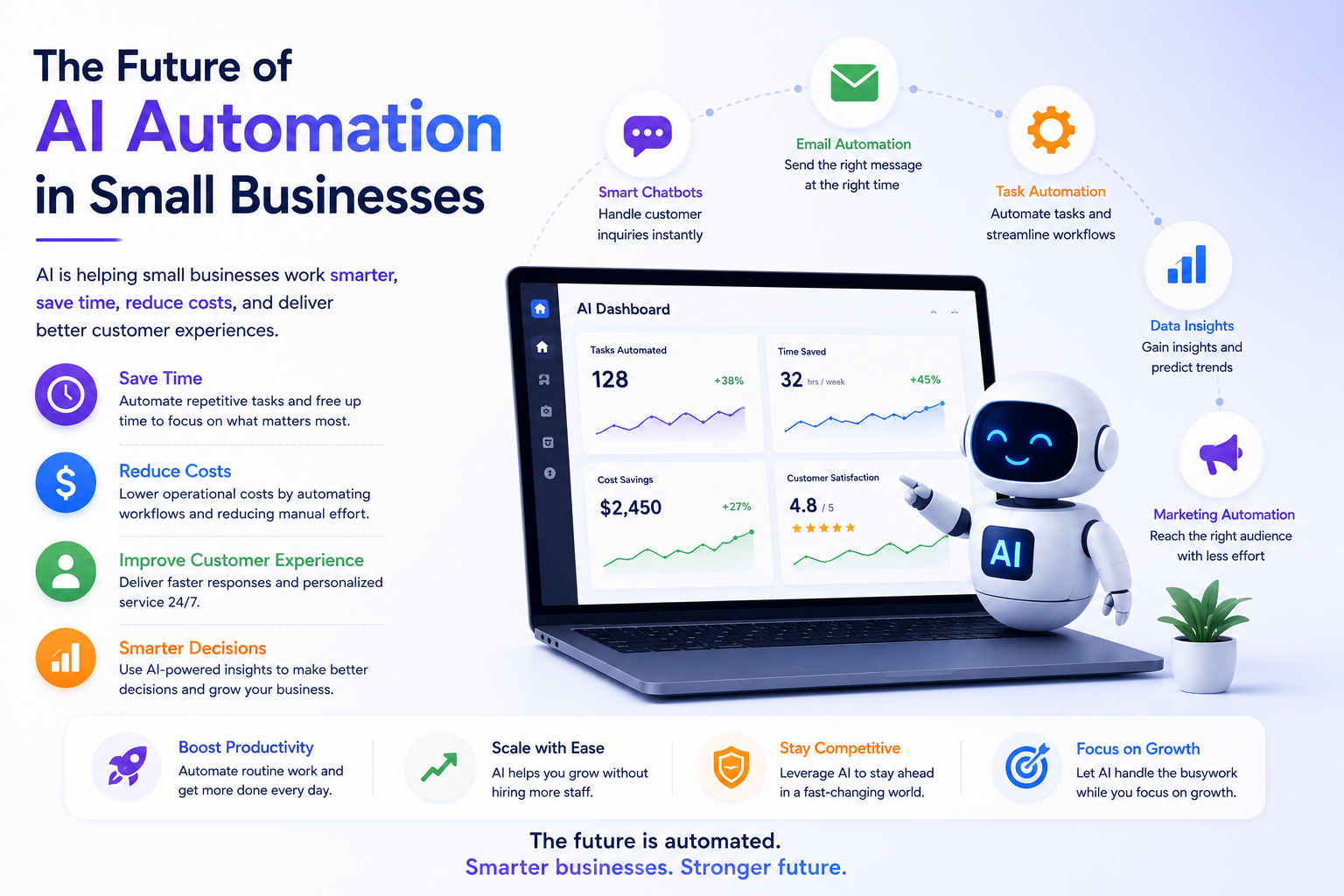
Artificial Intelligence (AI) is no longer a technology reserved for large corporations with massive budgets and dedicated technology teams. Today, AI automation is becoming increasingly accessible to small businesses, helping them streamline operations, improve customer experiences, reduce costs, and compete more effectively in the digital marketplace.
As technology continues to evolve, small businesses are discovering new ways to leverage AI-powered tools to automate repetitive tasks, enhance productivity, and make data-driven decisions. From customer support and marketing automation to sales optimization and workflow management, AI is transforming how businesses operate on a daily basis.
The future of AI automation promises even greater opportunities for small businesses. Companies that embrace AI early can gain a competitive advantage, improve efficiency, and position themselves for sustainable growth in an increasingly technology-driven world.
This article explores the future of AI automation in small businesses, its potential benefits, emerging trends, and how organizations can prepare for the next wave of digital transformation.
Understanding AI Automation
AI automation refers to the use of artificial intelligence technologies to perform tasks with minimal human intervention.
Unlike traditional automation, which follows predefined rules, AI-powered systems can learn from data, identify patterns, make predictions, and continuously improve performance over time.
This enables businesses to automate more complex processes that previously required human decision-making.
For small businesses, AI automation can handle customer inquiries, analyze data, manage marketing campaigns, schedule appointments, process transactions, and optimize workflows.
By reducing manual effort, businesses can focus on strategic growth activities rather than repetitive administrative tasks.
Why AI Automation Matters for Small Businesses
Small businesses often operate with limited resources, smaller teams, and tighter budgets compared to larger enterprises.
As a result, efficiency becomes essential for maintaining profitability and supporting growth.
AI automation helps businesses accomplish more without significantly increasing operational costs.
Tasks that once required hours of manual work can now be completed automatically and accurately.
This allows business owners and employees to dedicate more time to customer service, innovation, and business development.
The ability to achieve more with fewer resources is one of the main reasons AI automation is becoming increasingly valuable for small businesses.
The Rise of AI-Powered Customer Support
Customer service is one of the areas where AI automation is already making a significant impact.
Modern customers expect fast responses and personalized support regardless of the time of day.
AI-powered chatbots and virtual assistants allow businesses to provide instant support around the clock.
These systems can answer common questions, assist customers with purchases, schedule appointments, and collect important information before transferring complex issues to human representatives.
As AI technology continues to improve, customer support systems will become more intelligent and capable of handling increasingly sophisticated interactions.
This will enable small businesses to deliver enterprise-level customer experiences without requiring large support teams.
Smarter Marketing Through AI
Marketing is another area experiencing rapid transformation through AI automation.
Traditional marketing often requires significant manual effort to create campaigns, analyze performance, and engage with customers.
AI helps automate these activities while improving effectiveness.
Businesses can use AI to generate content ideas, personalize email campaigns, optimize advertising strategies, identify target audiences, and predict customer behavior.
Future AI marketing platforms will become even more advanced, allowing small businesses to deliver highly personalized experiences at scale.
This level of automation can significantly improve lead generation, customer engagement, and return on investment.
AI-Driven Sales Automation
Sales processes involve numerous repetitive activities, including lead qualification, follow-up communication, data entry, and customer relationship management.
AI automation helps streamline these processes by identifying high-potential leads, analyzing customer behavior, and recommending the most effective sales actions.
Future AI systems will provide even deeper insights into customer intent and purchasing behavior.
Sales teams will be able to focus on building relationships and closing deals while AI handles administrative and analytical tasks.
This increased efficiency can help small businesses generate more revenue without expanding their sales teams significantly.
Improving Decision-Making with Data Analytics
Many small businesses collect large amounts of data but struggle to transform that information into actionable insights.
AI-powered analytics tools help businesses analyze customer behavior, market trends, operational performance, and financial data.
Instead of manually reviewing reports, business owners can receive real-time insights and recommendations generated by intelligent systems.
Future AI platforms will become even more sophisticated, providing predictive analytics that help businesses anticipate customer needs, identify opportunities, and reduce risks.
Data-driven decision-making will become more accessible and valuable for organizations of all sizes.
Automating Administrative Tasks
Administrative work consumes a significant portion of time in many small businesses.
Tasks such as scheduling, invoicing, payroll processing, inventory management, and document handling often require ongoing manual effort.
AI automation can streamline these processes by reducing repetitive work and minimizing human errors.
As AI technology advances, businesses will increasingly rely on intelligent assistants that manage routine operations automatically.
This will improve efficiency while allowing employees to focus on higher-value activities that contribute directly to business growth.
Personalized Customer Experiences
Modern consumers expect personalized interactions with businesses.
AI helps deliver these experiences by analyzing customer preferences, purchasing history, and behavioral patterns.
Businesses can use AI to recommend products, personalize marketing messages, and tailor customer journeys based on individual needs.
Future AI systems will provide even more advanced personalization capabilities, helping small businesses compete with larger organizations that have traditionally dominated customer experience innovation.
Personalization not only improves customer satisfaction but also increases loyalty and conversion rates.
Cost Reduction and Operational Efficiency
One of the most compelling benefits of AI automation is its ability to reduce costs.
By automating repetitive tasks, businesses can increase productivity without continuously expanding their workforce.
AI helps reduce manual errors, optimize resource allocation, and improve workflow efficiency.
Over time, these improvements contribute to lower operating expenses and higher profitability.
For small businesses operating with limited budgets, cost efficiency can provide a significant competitive advantage.
The Role of AI in E-Commerce Growth
E-commerce businesses are increasingly using AI to improve customer experiences and optimize operations.
AI-powered recommendation engines help customers discover relevant products, while automated inventory management systems improve supply chain efficiency.
Future AI technologies will enhance product search capabilities, customer support, dynamic pricing strategies, and fraud detection systems.
Small e-commerce businesses that embrace AI automation will be better equipped to compete in an increasingly crowded online marketplace.
AI-driven efficiency can support growth while improving customer satisfaction and retention.
Challenges Small Businesses May Face
While AI automation offers significant benefits, implementation is not without challenges.
Some businesses may face concerns related to cost, data privacy, technology adoption, and employee training.
Integrating AI systems into existing workflows can require careful planning and ongoing management.
Businesses must also ensure that automation enhances customer experiences rather than creating impersonal interactions.
The most successful organizations will be those that balance automation with human expertise and maintain a customer-focused approach.
Emerging Trends Shaping the Future
Several emerging trends are expected to shape the future of AI automation in small businesses.
AI-powered assistants will become more intelligent and capable of managing increasingly complex tasks.
Voice-based interactions will continue to grow as businesses adopt conversational AI technologies.
Predictive analytics will help organizations make more informed decisions and identify growth opportunities.
AI-driven workflow automation will become more accessible through no-code and low-code platforms, allowing businesses to implement advanced solutions without extensive technical expertise.
These developments will make AI automation more practical and valuable for organizations of all sizes.
How Small Businesses Can Prepare for the Future
Preparing for the future of AI automation begins with understanding business needs and identifying areas where automation can deliver the greatest value.
Businesses should focus on processes that are repetitive, time-consuming, and prone to human error.
Investing in employee training and digital transformation initiatives can help organizations adapt more effectively to technological change.
Small businesses that embrace innovation and remain open to new technologies will be better positioned to take advantage of future opportunities.
The key is to view AI not as a replacement for employees but as a tool that enhances productivity and supports business growth.
Conclusion
The future of AI automation in small businesses is filled with opportunities for growth, efficiency, and innovation. As AI technology becomes more accessible and affordable, businesses of all sizes can leverage intelligent automation to improve customer experiences, streamline operations, reduce costs, and make better decisions.
From customer support and marketing automation to sales optimization and predictive analytics, AI is transforming the way small businesses operate. Organizations that embrace these technologies early will gain significant advantages in productivity, competitiveness, and long-term sustainability.
While challenges remain, the potential benefits far outweigh the obstacles. The future belongs to businesses that combine human creativity and expertise with the power of intelligent automation. By adopting AI strategically, small businesses can unlock new opportunities, accelerate growth, and thrive in an increasingly digital world.
Add a Comment