

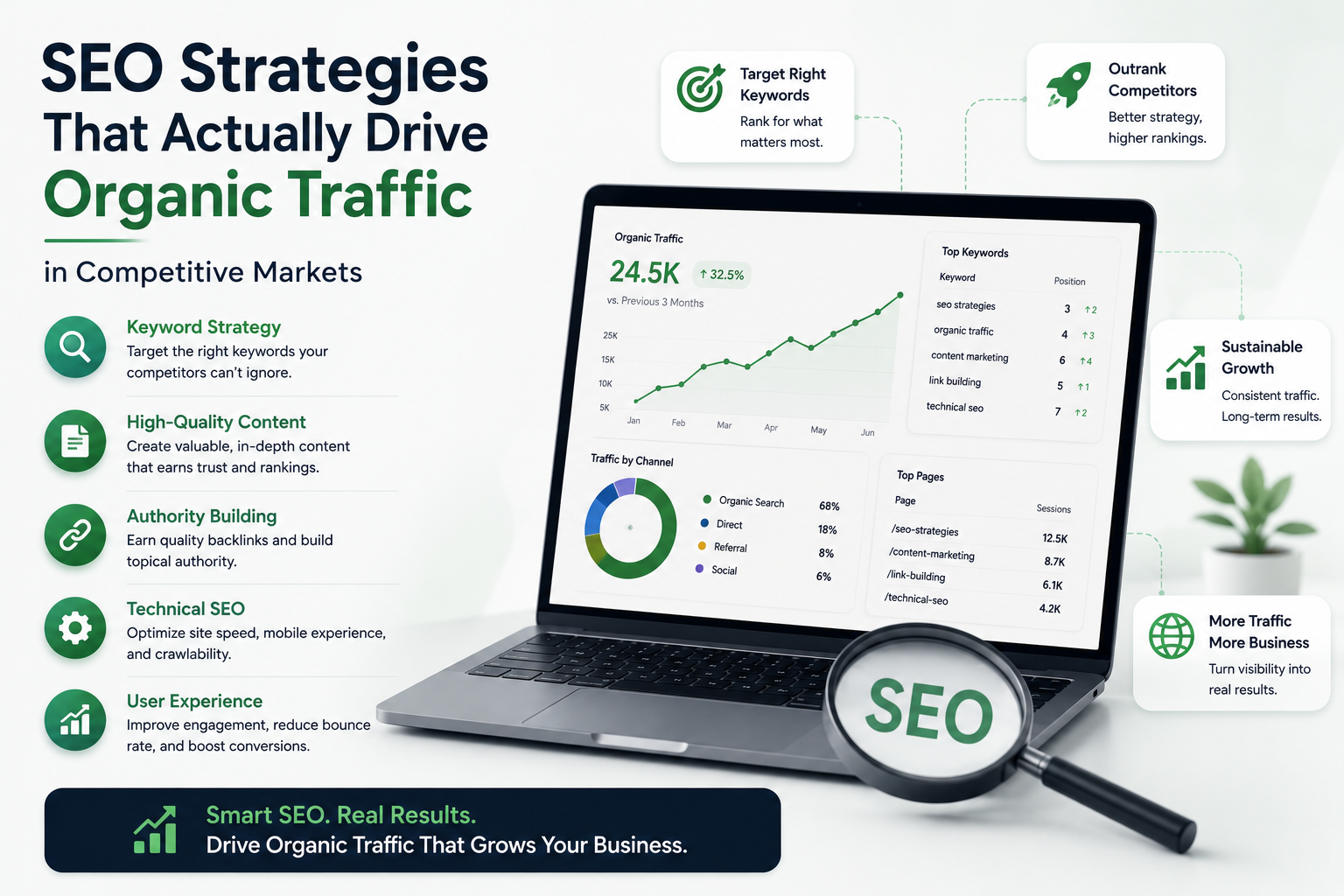
Introduction
Ranking on Google has become significantly more challenging than it was a few years ago. Businesses today compete not only with local competitors but also with established brands, industry leaders, media websites, and content publishers that have invested heavily in search engine optimization. In highly competitive markets, simply publishing content and adding keywords is no longer enough to achieve meaningful results.
The reality is that successful SEO requires a strategic approach focused on relevance, authority, user experience, and long-term value. Businesses that consistently generate organic traffic understand that search engine optimization is not about finding shortcuts but about building a strong digital presence that search engines trust.
This guide explores the SEO strategies that genuinely drive organic traffic in competitive industries and help businesses achieve sustainable growth.
Understanding Modern SEO Competition
Search engines have become much smarter in evaluating websites. Google’s algorithms now focus heavily on user intent, content quality, website experience, and authority signals when determining rankings.
In competitive markets, thousands of websites may target the same keywords. Ranking successfully requires businesses to offer something better, more comprehensive, and more valuable than competing pages.
The goal is no longer to simply rank for keywords. The goal is to become the most useful and trustworthy result for users searching for information, products, or services.
Start with Search Intent, Not Just Keywords
One of the biggest mistakes businesses make is focusing entirely on keyword volume while ignoring search intent.
Search intent refers to the reason behind a user’s search. Someone searching for information wants a different experience than someone ready to purchase a product or request a service.
Understanding search intent allows businesses to create content that directly answers user questions and satisfies their needs. Search engines reward websites that provide the most relevant solution to a user’s query.
Before creating any content, businesses should analyze what users are actually looking for and build content around those expectations rather than simply targeting keywords.
Create Content That Goes Beyond Competitors
Competitive markets require exceptional content.
Many businesses publish articles that simply repeat information already available online. This approach rarely generates significant organic traffic because search engines already have numerous similar pages indexed.
Successful content should provide deeper insights, updated information, practical examples, expert perspectives, and actionable solutions.
When users spend more time engaging with content because it provides real value, search engines recognize those positive signals and often reward the page with better visibility.
Instead of asking, “How can we rank for this keyword?” businesses should ask, “How can we create the best resource available on this topic?”
Focus on Topic Authority Rather Than Individual Keywords
Search engines increasingly evaluate websites based on overall expertise within a subject area.
Rather than creating isolated pages targeting individual keywords, businesses should build comprehensive content ecosystems around core topics.
For example, a digital marketing company targeting SEO services should publish related content covering technical SEO, local SEO, link building, content marketing, keyword research, SEO audits, and search engine trends.
This approach helps search engines recognize the website as an authoritative source within its industry.
As topical authority grows, rankings often improve across multiple keywords instead of just a few individual phrases.
Invest in Long-Form, High-Value Content
Long-form content continues to perform exceptionally well in competitive industries because it provides opportunities to cover topics in greater detail.
Comprehensive content naturally answers more questions, targets more related keywords, and offers a better user experience.
High-performing content often includes:
-
Detailed explanations
-
Real-world examples
-
Expert insights
-
Industry statistics
-
Frequently asked questions
-
Practical recommendations
The objective is not to increase word count unnecessarily but to ensure that every important aspect of a topic is addressed thoroughly.
Strengthen Your Internal Linking Structure
Many websites underestimate the impact of internal linking on SEO performance.
Internal links help search engines understand relationships between pages while guiding visitors toward additional valuable content.
A strong internal linking strategy distributes authority throughout the website and improves crawlability.
When related pages are connected strategically, search engines gain a clearer understanding of the website’s expertise and content hierarchy.
This often contributes to improved rankings and better user engagement.
Build High-Quality Backlinks Consistently
Backlinks remain one of the strongest ranking signals in search engine optimization.
In competitive markets, websites with stronger backlink profiles typically have a significant advantage.
However, quality matters far more than quantity.
Businesses should focus on earning links through valuable content, industry partnerships, guest contributions, original research, and digital PR efforts.
A single backlink from a respected industry publication can often provide more value than dozens of low-quality links from irrelevant websites.
Authority is built gradually through consistent effort and genuine credibility.
Optimize for User Experience
Search engines increasingly prioritize websites that provide excellent user experiences.
Factors such as page speed, mobile responsiveness, navigation, readability, and accessibility influence both rankings and user satisfaction.
Visitors expect websites to load quickly and function smoothly across all devices.
If users leave a website because of poor performance, search engines may interpret that behavior as a signal that the page is not meeting expectations.
Investing in user experience improvements often produces SEO benefits alongside better conversion rates.
Leverage Content Refresh Strategies
Many businesses focus exclusively on creating new content while neglecting existing pages.
Refreshing older content is often one of the fastest ways to improve rankings and increase organic traffic.
Updating outdated information, adding new insights, improving readability, expanding sections, and optimizing for current search trends can significantly improve performance.
Search engines tend to favor content that remains accurate, relevant, and useful over time.
Regular content updates demonstrate ongoing value and commitment to quality.
Prioritize Technical SEO Foundations
Even the best content may struggle to rank if technical SEO issues prevent search engines from properly crawling and indexing a website.
Technical optimization ensures that search engines can efficiently access and understand website content.
Important areas include website speed, structured data, mobile usability, secure HTTPS connections, clean URL structures, XML sitemaps, and proper indexing controls.
A technically sound website provides the foundation upon which all other SEO efforts depend.
Ignoring technical SEO can limit the effectiveness of every other optimization strategy.
Build Brand Authority Beyond Search Engines
Google increasingly favors recognizable and trusted brands.
Businesses that invest in brand building often see indirect SEO benefits through increased search demand, higher engagement, more backlinks, and stronger trust signals.
Publishing thought leadership content, participating in industry discussions, appearing in reputable publications, and maintaining active social media profiles all contribute to brand authority.
As brand recognition grows, search engines gain more confidence in the website’s credibility and expertise.
Strong brands often achieve rankings that are difficult for lesser-known competitors to match.
Focus on Conversion-Oriented Traffic
Organic traffic alone is not the ultimate goal.
Businesses should prioritize attracting visitors who are genuinely interested in their products, services, or expertise.
Highly targeted traffic often delivers better business outcomes than large volumes of untargeted visitors.
By aligning content with customer needs throughout the buying journey, businesses can generate leads, inquiries, and sales while improving overall SEO performance.
The most successful SEO strategies focus on quality traffic rather than simply maximizing visitor numbers.
Measuring SEO Success
Effective SEO requires continuous monitoring and improvement.
Businesses should regularly evaluate performance indicators such as organic traffic growth, keyword visibility, user engagement, lead generation, conversion rates, and backlink acquisition.
SEO is not a one-time project but an ongoing process that evolves alongside search engine algorithms and user behavior.
Organizations that consistently analyze data and refine their strategies are more likely to maintain long-term competitive advantages.
Conclusion
Driving organic traffic in competitive markets requires more than basic optimization techniques. Businesses must create exceptional content, understand user intent, build authority, improve technical performance, and deliver outstanding user experiences.
The most successful SEO strategies focus on long-term value rather than short-term ranking tactics. By developing topical authority, earning quality backlinks, optimizing website performance, and continuously improving content, businesses can achieve sustainable organic growth even in highly competitive industries.
While SEO results rarely happen overnight, organizations that invest in proven strategies and maintain consistency often build a powerful source of traffic, leads, and revenue that continues to grow over time. In today’s competitive digital landscape, strategic SEO remains one of the most effective investments a business can make for long-term online success.
A wonderful serenity has taken possession of my entire soul, like these sweet mornings of spring which I enjoy with my whole heart. I am alone, and feel the charm of existence in this spot, which was created for the bliss of souls like mine. I am so happy.
my dear friend, so absorbed in the exquisite sense of mere tranquil existence, that I neglect my talents.
I feel that I never was a greater artist than now. When, while the lovely valley teems with vapour around me, and the meridian sun strikes the upper surface of the impenetrable foliage of my trees, and but a few stray gleams steal into the inner sanctuary.