

Introduction
If you’re a business owner looking to grow your online presence, you’ve likely heard about SEO. Search Engine Optimization (SEO) is one of the most powerful digital marketing strategies for increasing website traffic, generating qualified leads, and improving online visibility. However, many business owners struggle to understand the difference between On-Page SEO and Off-Page SEO.
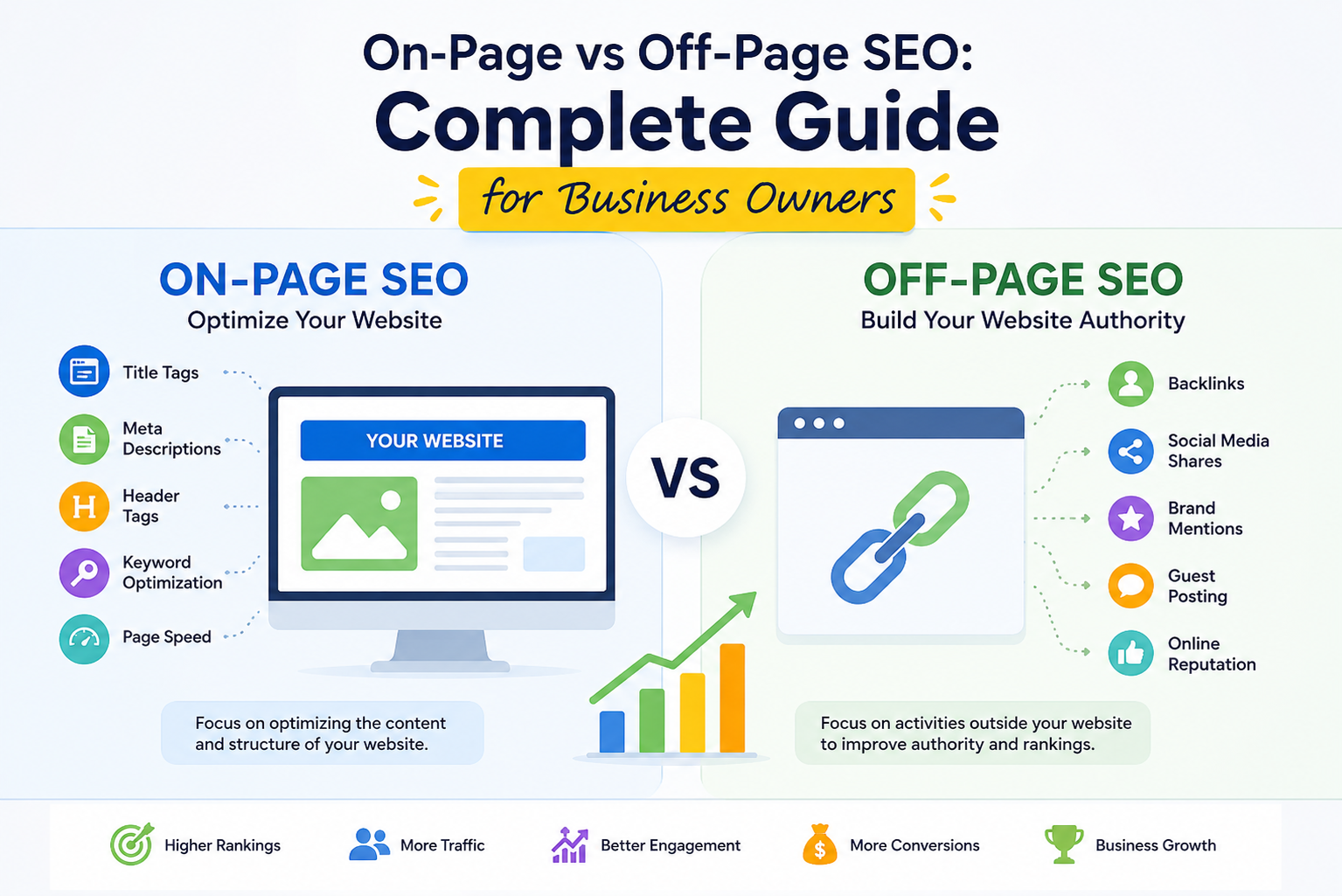
Both are essential components of a successful SEO strategy, but they serve different purposes. On-Page SEO focuses on optimizing elements within your website, while Off-Page SEO focuses on building authority and trust outside your website.
In this comprehensive guide, we’ll break down the differences, benefits, techniques, and best practices of On-Page and Off-Page SEO to help you understand how they work together to improve your search engine rankings.
What is SEO and Why Does It Matter?
SEO (Search Engine Optimization) is the process of improving your website’s visibility on search engines like Google, Bing, and Yahoo. The higher your website ranks in search results, the more likely potential customers are to find your business.
Modern consumers rely heavily on search engines when researching products, services, and solutions. If your website isn’t visible in search results, you’re missing valuable opportunities to attract new customers and grow your business.
Effective SEO helps businesses:
- Increase organic website traffic
- Improve brand awareness
- Generate qualified leads
- Build credibility and trust
- Improve user experience
- Boost long-term ROI
SEO can be divided into three main categories:
- On-Page SEO
- Off-Page SEO
- Technical SEO
For this article, we’ll focus on the first two and explain how they contribute to your online success.
What is On-Page SEO?
On-Page SEO refers to all optimization efforts that take place directly on your website. These optimizations help search engines understand your content while improving the user experience for visitors.
Think of On-Page SEO as the foundation of your website. Without a properly optimized website, even the strongest Off-Page SEO efforts may not deliver the desired results.
The primary goal of On-Page SEO is to ensure that every page on your website is relevant, valuable, and easy for search engines to understand.
Key Elements of On-Page SEO
1. High-Quality Content
Content is the backbone of On-Page SEO. Search engines prioritize content that provides value, answers user questions, and satisfies search intent.
High-quality content should:
- Be original and informative
- Address customer pain points
- Include relevant keywords naturally
- Offer actionable insights
- Be regularly updated
Businesses that consistently publish useful content often achieve higher search rankings and better engagement.
2. Keyword Optimization
Keywords help search engines understand what your content is about.
Proper keyword optimization includes:
- Using primary keywords in titles
- Including keywords in headings
- Adding keywords naturally throughout content
- Using semantic and related keywords
- Avoiding keyword stuffing
For example, if your target keyword is “On-Page vs Off-Page SEO”, it should appear naturally in strategic locations throughout the page.
3. SEO-Friendly Title Tags
Title tags are among the most important On-Page ranking factors.
A strong title tag should:
- Include your target keyword
- Be compelling for users
- Stay under 60 characters
- Clearly describe the page topic
Example:
On-Page vs Off-Page SEO: Complete Guide for Business Owners
4. Meta Descriptions
Meta descriptions provide a brief summary of your page in search results.
An optimized meta description should:
- Include relevant keywords
- Encourage users to click
- Explain page value
- Remain concise and informative
While meta descriptions aren’t direct ranking factors, they significantly impact click-through rates.
5. Header Tags (H1, H2, H3)
Header tags help organize content and improve readability.
Benefits include:
- Better content structure
- Improved user experience
- Easier navigation
- Enhanced keyword relevance
Proper heading hierarchy helps search engines understand your content more effectively.
6. Internal Linking
Internal links connect pages within your website.
Benefits include:
- Better crawlability
- Improved user navigation
- Increased page authority distribution
- Longer visitor engagement
Strategic internal linking strengthens your overall SEO structure.
7. Image Optimization
Images improve engagement but must be optimized correctly.
Best practices include:
- Descriptive file names
- Proper alt text
- Compressed file sizes
- Modern image formats
Optimized images improve page speed and accessibility.
8. Mobile Responsiveness
Most internet users now browse websites on mobile devices.
A mobile-friendly website should:
- Load quickly
- Display properly on all devices
- Offer easy navigation
- Maintain readable content
Google prioritizes mobile-first indexing, making mobile optimization essential.
9. Page Speed Optimization
Website speed directly affects rankings and user satisfaction.
Slow websites often experience:
- Higher bounce rates
- Lower conversions
- Poor user experience
Improving page speed can significantly enhance both SEO performance and customer engagement.
Benefits of On-Page SEO
When implemented correctly, On-Page SEO can help businesses:
- Improve search rankings
- Increase organic traffic
- Enhance user experience
- Improve conversion rates
- Reduce bounce rates
- Generate more qualified leads
On-Page SEO gives businesses complete control over how their website performs in search engines.
What is Off-Page SEO?
Off-Page SEO refers to all activities performed outside your website to improve its authority, credibility, and search engine rankings.
While On-Page SEO helps search engines understand your content, Off-Page SEO helps search engines trust your website.
Search engines view Off-Page signals as endorsements of your website’s quality and relevance.
Key Elements of Off-Page SEO
1. Link Building
Backlinks remain one of the strongest ranking factors in SEO.
A backlink occurs when another website links to your content.
High-quality backlinks:
- Increase domain authority
- Improve search rankings
- Drive referral traffic
- Build trust and credibility
Quality is far more important than quantity when building backlinks.
2. Guest Posting
Guest posting involves publishing content on reputable websites within your industry.
Benefits include:
- Increased brand visibility
- High-quality backlinks
- New audience exposure
- Improved authority
Guest posting remains one of the most effective Off-Page SEO strategies.
3. Brand Mentions
Search engines pay attention to how often your brand is mentioned online.
Brand mentions help:
- Build authority
- Improve trust signals
- Increase recognition
- Strengthen online reputation
Even unlinked brand mentions can contribute to your overall SEO performance.
4. Social Media Marketing
Although social media isn’t a direct ranking factor, it plays an important role in Off-Page SEO.
Social media helps:
- Increase content reach
- Drive website traffic
- Generate engagement
- Improve brand awareness
A strong social presence supports broader SEO efforts.
5. Online Reviews
Customer reviews influence both reputation and local SEO rankings.
Positive reviews help businesses:
- Build trust
- Increase conversions
- Improve visibility
- Strengthen credibility
Google reviews, industry-specific reviews, and customer testimonials all contribute to your online reputation.
6. Influencer Outreach
Partnering with industry influencers can help expand your reach and attract new audiences.
Influencer collaborations often result in:
- More traffic
- Better visibility
- Higher engagement
- Additional backlinks
Influencer marketing can significantly enhance Off-Page SEO efforts.
7. Local Citations
Local citations are online references to your business information.
Examples include:
- Business directories
- Local listings
- Industry platforms
Consistent citations improve local search visibility and credibility.
Benefits of Off-Page SEO
Effective Off-Page SEO can help businesses:
- Increase domain authority
- Improve search rankings
- Build trust and credibility
- Expand brand awareness
- Generate referral traffic
- Strengthen online reputation
Off-Page SEO acts as a vote of confidence for your website in the eyes of search engines.
On-Page SEO vs Off-Page SEO: Key Differences
| Feature | On-Page SEO | Off-Page SEO |
|---|---|---|
| Focus | Website Optimization | Website Authority |
| Location | Within Website | Outside Website |
| Goal | Relevance | Trust |
| Control | Full Control | Limited Control |
| Examples | Content, Keywords, Speed | Backlinks, Reviews, Mentions |
| Impact | User Experience | Domain Authority |
Both strategies are essential for achieving sustainable SEO success.
Which SEO Strategy is More Important?
Many business owners wonder whether they should focus on On-Page SEO or Off-Page SEO first.
The truth is that neither works effectively without the other.
A website with strong On-Page SEO but no authority may struggle to rank.
Likewise, a website with many backlinks but poor content and user experience may fail to convert visitors.
The most successful SEO campaigns balance both approaches.
How On-Page and Off-Page SEO Work Together
Imagine your website as a business building.
On-Page SEO creates the structure, design, and functionality.
Off-Page SEO builds the reputation and trust that encourage people to visit.
When combined, they create a powerful SEO strategy that:
- Improves rankings
- Attracts more traffic
- Generates leads
- Increases sales
- Builds long-term authority
This combination is what drives sustainable online growth.
Common SEO Mistakes Business Owners Should Avoid
Many businesses fail to achieve results because they make avoidable SEO mistakes.
Some of the most common include:
- Ignoring keyword research
- Publishing thin or duplicate content
- Buying low-quality backlinks
- Neglecting mobile optimization
- Overlooking page speed
- Using poor internal linking structures
- Ignoring local SEO opportunities
- Failing to monitor performance
Avoiding these mistakes can significantly improve your SEO success.
Final Thoughts
Understanding the difference between On-Page SEO and Off-Page SEO is essential for any business looking to succeed online. On-Page SEO helps search engines understand your content and provides a better experience for visitors, while Off-Page SEO builds trust, authority, and credibility across the internet.
Neither strategy should be ignored. Businesses that invest in both On-Page and Off-Page SEO create a strong digital foundation that supports long-term growth, higher search rankings, and increased revenue.
If your goal is to attract more customers, generate quality leads, and establish a strong online presence, a balanced SEO strategy that combines both On-Page and Off-Page optimization is the key to success.
A wonderful serenity has taken possession of my entire soul, like these sweet mornings of spring which I enjoy with my whole heart. I am alone, and feel the charm of existence in this spot, which was created for the bliss of souls like mine. I am so happy.
my dear friend, so absorbed in the exquisite sense of mere tranquil existence, that I neglect my talents.
I feel that I never was a greater artist than now. When, while the lovely valley teems with vapour around me, and the meridian sun strikes the upper surface of the impenetrable foliage of my trees, and but a few stray gleams steal into the inner sanctuary.