

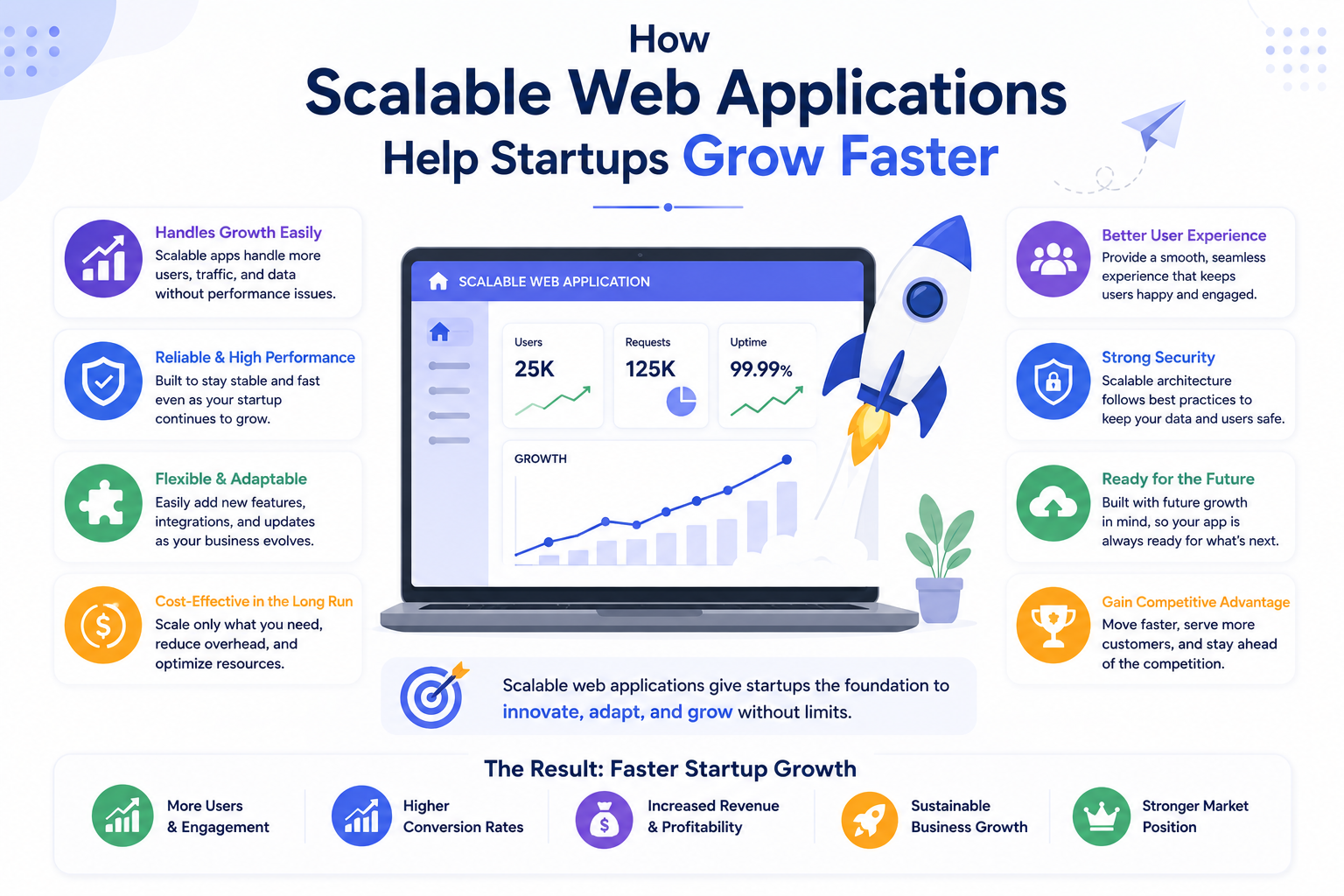
Introduction
For startups, growth is the ultimate goal. Every new customer, product launch, partnership, or marketing campaign is designed to help the business expand and capture a larger share of the market. However, rapid growth often brings new challenges. As traffic increases and customer demands evolve, many startups discover that their technology infrastructure struggles to keep up.
This is where scalable web applications become essential. A scalable web application is designed to handle increasing numbers of users, transactions, and data without sacrificing performance, security, or user experience. Instead of rebuilding systems every time the business grows, startups can rely on scalable applications that adapt to changing demands seamlessly.
In today’s competitive digital landscape, scalability is not just a technical advantage—it is a business necessity. Startups that invest in scalable web applications position themselves for sustainable growth, improved customer satisfaction, and long-term success.
What is a Scalable Web Application?
A scalable web application is a software solution designed to grow alongside a business. It can efficiently manage increasing workloads, user activity, and data volume without experiencing significant performance issues.
Unlike traditional applications that may slow down or become unstable under heavy traffic, scalable applications are built using flexible architectures that allow resources and functionality to expand when needed.
This means startups can focus on growing their customer base and launching new services without constantly worrying about technical limitations.
Scalability ensures that technology supports business growth rather than becoming an obstacle to it.
Supporting Rapid User Growth
One of the biggest challenges startups face is handling sudden increases in user activity.
A successful marketing campaign, viral social media post, product launch, or positive media coverage can bring thousands of new users to a platform within a short period. If the application is not built to scale, this sudden surge can cause slow loading times, crashes, or complete downtime.
Scalable web applications are designed to handle these fluctuations efficiently. They can accommodate higher traffic volumes while maintaining performance and reliability.
This allows startups to capitalize on growth opportunities without risking customer frustration or lost revenue.
When businesses can confidently handle increasing demand, they are better positioned to expand and compete effectively.
Delivering Better User Experiences
User experience plays a crucial role in startup success.
Modern customers expect websites and applications to load quickly, function smoothly, and remain accessible at all times. Poor performance can drive users away and damage a company’s reputation.
Scalable web applications help ensure consistent performance regardless of the number of users interacting with the platform.
Whether a startup has one hundred users or one hundred thousand users, a scalable system maintains responsiveness and reliability.
Positive user experiences increase engagement, encourage repeat visits, and improve customer retention, all of which contribute to faster business growth.
Reducing Downtime and Business Disruptions
Downtime can be costly for any business, especially startups trying to build trust and credibility.
When applications crash or become unavailable during periods of high demand, businesses risk losing customers, revenue, and valuable opportunities.
Scalable web applications are designed with reliability in mind. They distribute workloads efficiently and support infrastructure that can adapt to increased demand.
This minimizes the risk of system failures and ensures continuous availability.
Customers are far more likely to trust and continue using platforms that provide reliable and uninterrupted service.
Supporting Product Innovation
Innovation is at the heart of most successful startups.
Businesses need the flexibility to introduce new features, improve functionality, and respond to changing customer expectations. However, outdated or inflexible systems often make innovation difficult.
Scalable web applications provide a flexible foundation that supports continuous improvement.
Development teams can add new features, integrate emerging technologies, and expand functionality without disrupting existing operations.
This adaptability allows startups to innovate quickly and remain competitive in fast-changing markets.
The ability to evolve efficiently is often a key factor separating successful startups from those that struggle to grow.
Improving Operational Efficiency
Startups typically operate with limited resources and small teams. Efficiency is therefore critical.
Scalable web applications streamline business processes by automating repetitive tasks, organizing data effectively, and supporting seamless integrations with other business tools.
As workloads increase, scalable systems help businesses manage operations without requiring proportional increases in staff or infrastructure.
This allows startups to maximize productivity while controlling costs.
Improved operational efficiency creates more opportunities for growth and enables teams to focus on strategic initiatives rather than technical challenges.
Enhancing Customer Satisfaction
Customer satisfaction is directly linked to business success.
Users expect digital products to be fast, reliable, and easy to use. When applications perform consistently, customers are more likely to trust the brand and continue using its services.
Scalable web applications help maintain a positive experience even during periods of rapid growth.
By ensuring smooth performance and minimizing technical issues, businesses can build stronger relationships with customers and encourage long-term loyalty.
Satisfied customers often become repeat users, advocates, and valuable sources of referrals.
Preparing for Future Growth
Many startups focus only on immediate requirements when building digital products.
While this approach may reduce initial development costs, it often creates challenges as the business expands.
Applications that are not designed for growth may require expensive redesigns, migrations, or complete rebuilds in the future.
Scalable web applications provide a future-ready foundation that can support evolving business needs.
Whether expanding into new markets, launching additional services, or accommodating larger customer bases, scalable systems make growth more manageable and cost-effective.
Planning for scalability from the beginning often saves significant time and resources later.
Attracting Investors and Stakeholders
Investors look for businesses that demonstrate long-term growth potential.
A startup with scalable technology infrastructure signals that it is prepared to handle increased demand and future expansion.
Scalable applications show that the business has considered long-term sustainability rather than focusing solely on short-term goals.
Investors are more likely to support companies that can grow efficiently without facing major technical limitations.
Strong technology foundations often increase confidence among investors, partners, and stakeholders.
Improving Security and Reliability
As startups grow, they collect more customer data and process larger volumes of information.
Security becomes increasingly important for protecting sensitive information and maintaining customer trust.
Scalable web applications are often built using modern development frameworks and security practices that support secure growth.
Reliable infrastructure, regular updates, and scalable architecture help reduce vulnerabilities and improve overall system stability.
A secure and dependable platform not only protects users but also strengthens brand credibility.
Supporting Global Expansion
Many startups eventually aim to expand beyond their local markets.
Global growth often introduces new challenges, including increased traffic, diverse user requirements, multiple payment systems, and higher data demands.
Scalable web applications provide the flexibility needed to support international growth.
Businesses can add new features, accommodate larger audiences, and deliver consistent performance across different regions without major infrastructure limitations.
This makes global expansion more achievable and less risky.
Gaining a Competitive Advantage
Competition in the digital marketplace continues to increase.
Customers have more choices than ever before, and businesses must deliver exceptional experiences to stand out.
Scalable web applications help startups maintain performance, reliability, and innovation as they grow.
Companies that can respond quickly to market opportunities and customer demands often gain a significant competitive advantage.
Scalability allows businesses to focus on growth and innovation rather than constantly addressing technical bottlenecks.
Why Scalability Should Be a Priority for Startups
Many startups underestimate the importance of scalability during the early stages of development.
However, building a scalable application from the beginning is often more cost-effective than redesigning systems later.
Scalability enables businesses to grow confidently, improve customer experiences, support innovation, and reduce operational challenges.
It creates a strong foundation for sustainable growth and helps startups avoid common obstacles that can slow progress.
Businesses that prioritize scalability are better prepared to adapt to changing market conditions and future opportunities.
Conclusion
Scalable web applications play a vital role in helping startups grow faster and more efficiently. They provide the flexibility needed to support increasing user demand, improve customer experiences, reduce downtime, enhance operational efficiency, and support continuous innovation.
As startups expand, scalable technology becomes one of their most valuable assets. It allows businesses to focus on growth, customer satisfaction, and market opportunities without being limited by technical constraints.
In an increasingly competitive digital world, startups that invest in scalable web applications gain a stronger foundation for long-term success. Scalability is not simply about handling more users—it is about creating a technology ecosystem that enables businesses to grow, adapt, and thrive at every stage of their journey.
A wonderful serenity has taken possession of my entire soul, like these sweet mornings of spring which I enjoy with my whole heart. I am alone, and feel the charm of existence in this spot, which was created for the bliss of souls like mine. I am so happy.
my dear friend, so absorbed in the exquisite sense of mere tranquil existence, that I neglect my talents.
I feel that I never was a greater artist than now. When, while the lovely valley teems with vapour around me, and the meridian sun strikes the upper surface of the impenetrable foliage of my trees, and but a few stray gleams steal into the inner sanctuary.