

Introduction
In today’s digital economy, data has become one of the most valuable assets for businesses. Every customer interaction, website visit, sales transaction, marketing campaign, and operational process generates data that can provide valuable insights. However, collecting data alone is not enough. The real challenge lies in analyzing that data effectively and using it to make smarter business decisions.
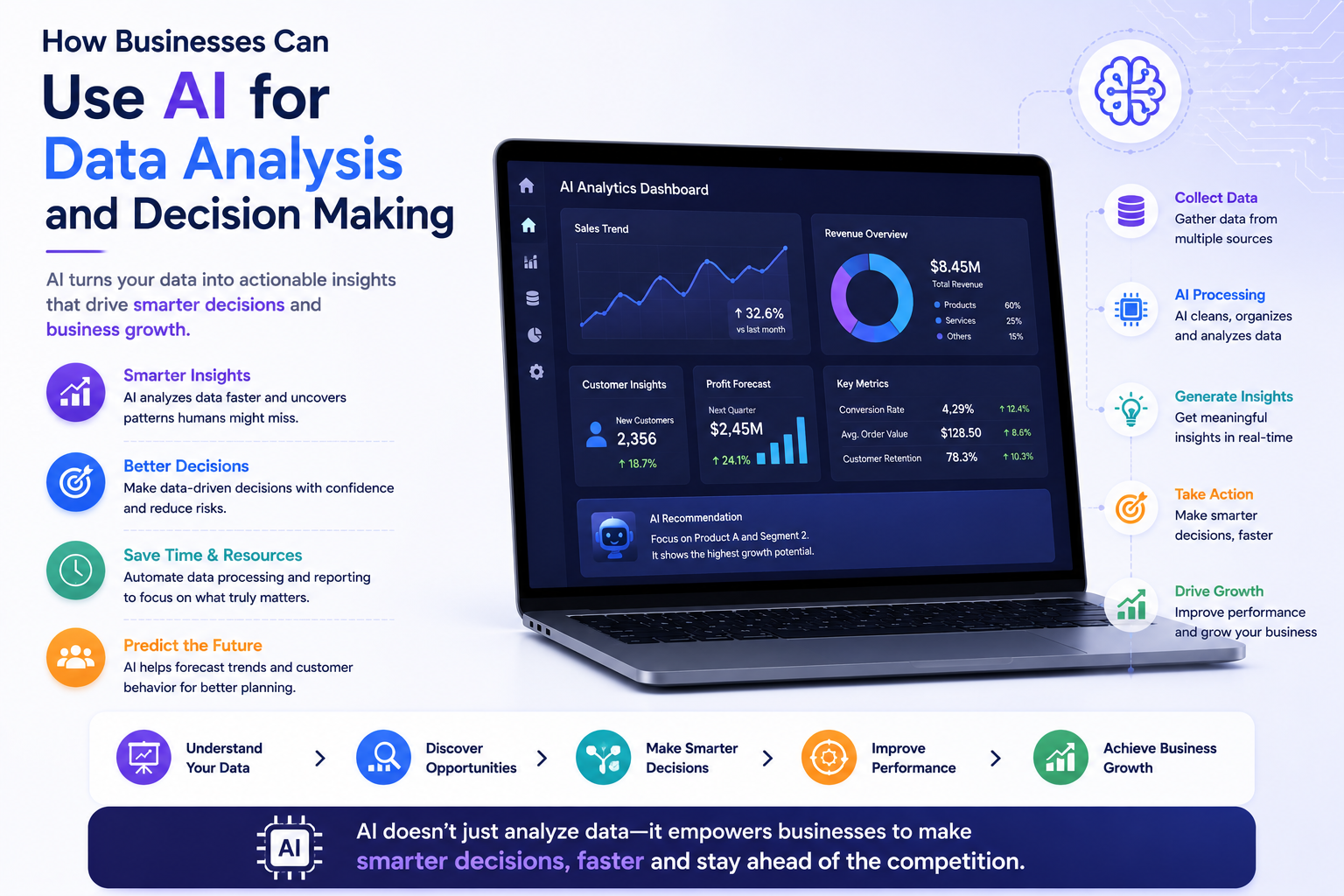
This is where Artificial Intelligence (AI) is transforming modern business operations. AI-powered data analysis enables organizations to process massive amounts of information quickly, identify patterns, uncover trends, and generate actionable insights that would be difficult or impossible to detect manually.
Businesses across industries are using AI to improve decision-making, optimize operations, predict customer behavior, enhance marketing strategies, and identify growth opportunities. As competition continues to increase, organizations that leverage AI-driven insights gain a significant advantage over those relying solely on traditional analysis methods.
This article explores how businesses can use AI for data analysis and decision-making and why it is becoming an essential tool for long-term success.
Understanding AI-Powered Data Analysis
AI-powered data analysis involves using artificial intelligence technologies such as machine learning, predictive analytics, natural language processing, and intelligent automation to process and interpret large volumes of data.
Unlike traditional data analysis methods that often require manual review and interpretation, AI systems can analyze information at scale and uncover insights in real time.
These systems continuously learn from new data, improving their accuracy and effectiveness over time.
By transforming raw data into meaningful information, AI helps businesses make faster, smarter, and more informed decisions.
Why Data-Driven Decision Making Matters
Business decisions based on assumptions or intuition can lead to costly mistakes.
Data-driven decision-making allows organizations to rely on facts, trends, and measurable outcomes rather than guesswork.
When businesses understand what is happening within their operations and customer base, they can identify opportunities, reduce risks, and allocate resources more effectively.
AI enhances this process by providing deeper insights and uncovering relationships within data that humans may overlook.
The result is improved accuracy, stronger performance, and better strategic planning.
Analyzing Customer Behavior
Understanding customer behavior is one of the most valuable applications of AI.
Businesses generate vast amounts of customer data through websites, mobile applications, social media platforms, purchase histories, and customer interactions.
AI can analyze this information to identify patterns in customer preferences, purchasing behavior, browsing habits, and engagement trends.
These insights help businesses understand what customers want, how they interact with products or services, and what influences their purchasing decisions.
By gaining a deeper understanding of customer behavior, organizations can create more personalized experiences and improve customer satisfaction.
Predicting Customer Needs
One of the most powerful capabilities of AI is predictive analytics.
Predictive analytics uses historical data and machine learning algorithms to forecast future outcomes and customer behaviors.
Businesses can predict which products customers are likely to purchase, identify customers at risk of leaving, and anticipate future demand.
These predictions allow organizations to take proactive actions rather than reacting after problems occur.
For example, businesses can launch targeted marketing campaigns, improve customer retention strategies, and optimize inventory levels based on predicted demand.
Predictive insights help businesses stay ahead of market changes and customer expectations.
Improving Marketing Performance
Marketing generates enormous amounts of data from advertising campaigns, social media activities, email marketing efforts, and website interactions.
AI helps businesses analyze this data to determine which strategies are producing the best results.
By evaluating customer engagement, conversion rates, audience behavior, and campaign performance, AI can identify opportunities for optimization.
Businesses can use these insights to improve targeting, personalize messaging, allocate budgets more effectively, and maximize return on investment.
AI-driven marketing decisions often lead to higher engagement, better lead generation, and increased revenue.
Enhancing Sales Strategies
Sales teams rely on accurate information to identify opportunities and close deals effectively.
AI can analyze customer interactions, purchasing history, engagement levels, and market trends to help sales professionals make informed decisions.
Businesses can identify high-value prospects, prioritize leads, and understand which sales strategies are most likely to succeed.
AI-powered lead scoring systems help sales teams focus on opportunities with the highest conversion potential.
This improves efficiency and increases the likelihood of achieving revenue goals.
Optimizing Business Operations
Operational efficiency is critical for business growth and profitability.
AI helps organizations analyze operational data to identify inefficiencies, bottlenecks, and areas for improvement.
Whether managing supply chains, production processes, customer service operations, or administrative workflows, AI provides valuable insights that support optimization efforts.
Businesses can reduce waste, improve productivity, and streamline processes by making data-driven operational decisions.
Improved efficiency often leads to lower costs and stronger overall performance.
Financial Analysis and Forecasting
Financial planning requires accurate analysis and forecasting.
AI helps businesses evaluate financial data, monitor spending patterns, identify risks, and predict future financial performance.
Organizations can use AI to generate forecasts related to revenue, expenses, cash flow, and profitability.
These insights support better budgeting, investment decisions, and resource allocation.
By improving financial visibility, businesses can make more confident decisions and prepare for future opportunities and challenges.
Improving Risk Management
Every business faces risks related to market changes, customer behavior, cybersecurity threats, and operational disruptions.
AI helps organizations identify potential risks by analyzing historical data and monitoring current conditions.
Machine learning models can detect unusual patterns, identify warning signs, and provide early alerts when potential issues arise.
This enables businesses to respond proactively and minimize negative impacts.
AI-driven risk management improves resilience and supports more informed decision-making.
Supporting Strategic Business Planning
Long-term business success depends on effective planning.
AI provides leaders with valuable insights that support strategic decision-making.
By analyzing market trends, customer behavior, competitive landscapes, and operational performance, AI helps businesses identify growth opportunities and make informed investments.
Organizations can evaluate potential scenarios, assess risks, and develop strategies based on reliable data rather than assumptions.
This leads to stronger business planning and improved long-term outcomes.
Real-Time Decision Making
In today’s fast-paced business environment, decisions often need to be made quickly.
Traditional reporting methods may not provide information fast enough to support immediate action.
AI systems can process data in real time and deliver instant insights to decision-makers.
Businesses can monitor performance, identify issues, and respond to changing conditions as they occur.
Real-time intelligence enables organizations to remain agile and competitive in dynamic markets.
Personalizing Customer Experiences
Personalization has become a major factor in customer satisfaction and loyalty.
AI helps businesses analyze customer preferences, purchasing patterns, and interaction histories to create highly personalized experiences.
Organizations can deliver customized recommendations, targeted offers, and relevant content based on individual customer needs.
Personalized experiences increase engagement, improve customer relationships, and drive higher conversion rates.
Businesses that leverage AI for personalization often gain a significant competitive advantage.
AI and Business Intelligence
Business Intelligence (BI) tools have long been used to analyze data and generate reports.
AI takes business intelligence to the next level by automating analysis and uncovering deeper insights.
Instead of simply displaying information, AI-powered BI systems explain trends, identify opportunities, and recommend actions.
This makes complex data easier to understand and helps decision-makers act with greater confidence.
The combination of AI and business intelligence is transforming how organizations use data to drive growth.
Challenges Businesses Should Consider
While AI offers significant advantages, successful implementation requires careful planning.
Businesses must ensure they have access to accurate, high-quality data and appropriate technology infrastructure.
Organizations should also consider privacy regulations, data security requirements, and ethical considerations when using AI.
Human oversight remains essential to ensure AI-generated insights are interpreted correctly and aligned with business objectives.
The most effective approach combines AI capabilities with human expertise and strategic thinking.
The Future of AI in Business Decision Making
AI technology continues to evolve rapidly.
Future advancements will provide even greater capabilities for predictive analytics, automation, customer intelligence, and strategic planning.
Businesses will increasingly rely on AI-powered systems to support decision-making across every department, from marketing and sales to finance and operations.
Organizations that embrace AI today will be better positioned to adapt to future market changes and maintain competitive advantages.
As data volumes continue to grow, AI will become an indispensable tool for transforming information into business value.
Conclusion
Artificial Intelligence is revolutionizing how businesses analyze data and make decisions. By processing large volumes of information, identifying patterns, predicting outcomes, and generating actionable insights, AI empowers organizations to make smarter, faster, and more informed decisions.
From understanding customer behavior and optimizing marketing campaigns to improving operational efficiency and forecasting financial performance, AI provides valuable capabilities that support business growth and innovation.
As competition becomes increasingly data-driven, organizations that leverage AI for analysis and decision-making gain significant advantages in efficiency, accuracy, and strategic planning. Businesses that embrace AI today are better equipped to navigate future challenges, seize new opportunities, and achieve long-term success in an increasingly digital world.
Add a Comment