

Introduction
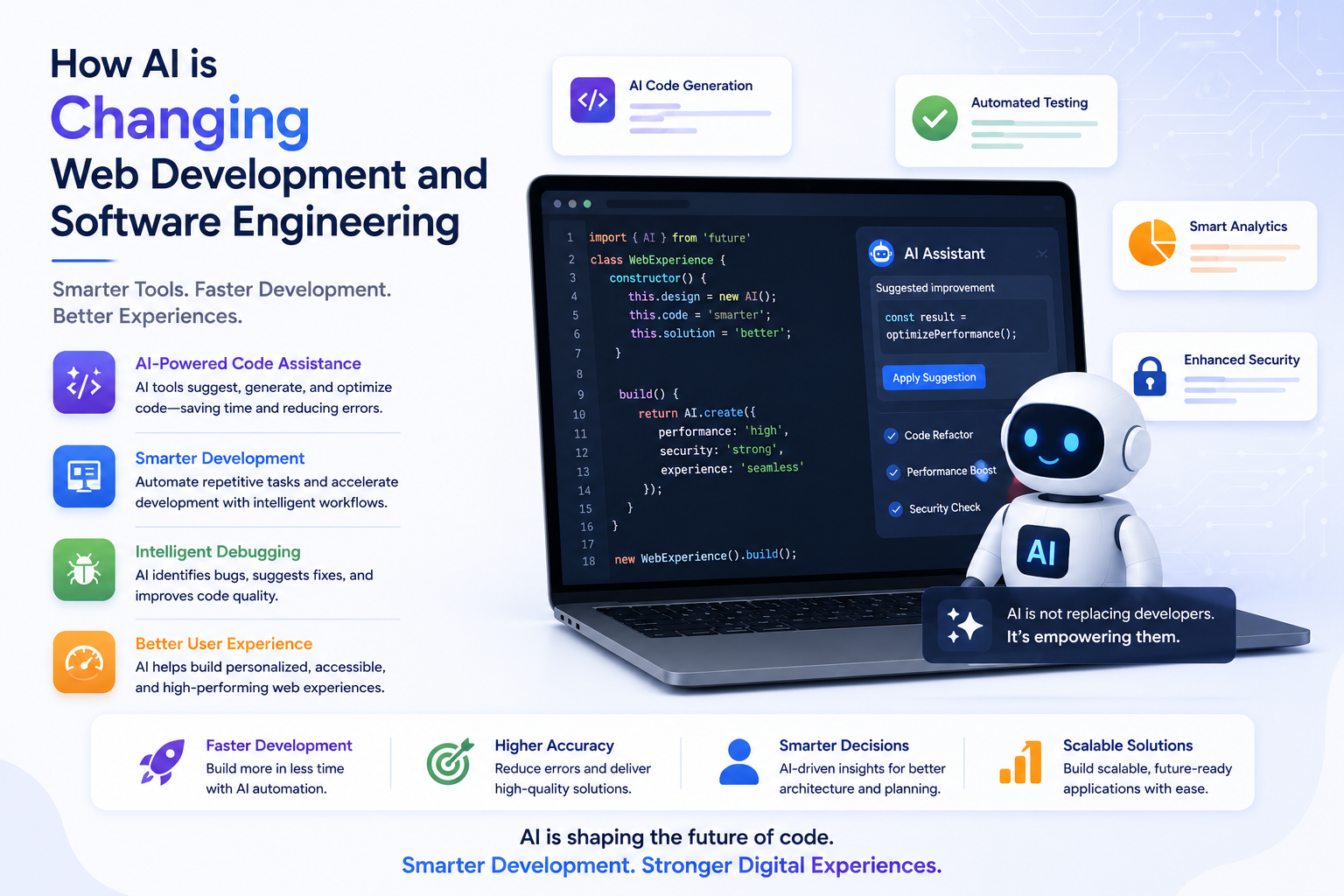
Artificial Intelligence (AI) is revolutionizing industries across the globe, and web development and software engineering are among the fields experiencing the most significant transformation. What once required countless hours of manual coding, testing, debugging, and maintenance can now be accelerated with the help of AI-powered tools and intelligent automation.
From code generation and bug detection to user experience optimization and software testing, AI is changing how developers build, deploy, and maintain digital products. Modern development teams are increasingly leveraging AI to improve productivity, reduce development time, enhance software quality, and deliver innovative solutions faster than ever before.
As businesses continue to demand faster development cycles and more advanced digital experiences, AI is becoming an essential component of modern software engineering. Understanding how AI is influencing development processes can help organizations stay competitive and take advantage of emerging opportunities.
The Evolution of AI in Software Development
Software development has traditionally been a labor-intensive process requiring significant human effort at every stage of the development lifecycle.
Developers spent hours writing code, identifying bugs, conducting tests, and maintaining systems. While development tools have evolved over the years, AI introduces a completely new level of automation and intelligence.
Modern AI systems can analyze code, suggest improvements, generate software components, predict issues, and automate repetitive tasks.
Rather than replacing developers, AI acts as an intelligent assistant that helps engineering teams work faster and more efficiently.
The result is improved productivity, reduced development costs, and faster delivery of high-quality software solutions.
AI-Powered Code Generation
One of the most noticeable changes AI has introduced to software engineering is automated code generation.
Modern AI coding assistants can generate code snippets, functions, user interfaces, and even complete application components based on simple instructions.
Developers can describe what they want to build, and AI tools can provide working code suggestions that significantly reduce development time.
This capability helps engineers focus on solving complex business problems rather than spending excessive time on repetitive coding tasks.
By accelerating development workflows, AI enables businesses to launch products faster and respond more quickly to market demands.
Faster Software Development Cycles
Speed is a critical factor in modern software development.
Businesses often compete based on how quickly they can release new features, update applications, and respond to customer needs.
AI helps accelerate development cycles by automating many tasks that previously required manual effort.
Code generation, documentation assistance, debugging support, testing automation, and deployment optimization all contribute to faster project delivery.
Development teams can complete projects more efficiently while maintaining high standards of quality and performance.
This increased speed gives businesses a competitive advantage in rapidly changing markets.
Improved Code Quality
Writing code quickly is important, but maintaining quality is equally critical.
Poor-quality code can lead to bugs, security vulnerabilities, performance issues, and costly maintenance requirements.
AI-powered tools help developers improve code quality by analyzing codebases and identifying potential problems before they become serious issues.
These systems can recommend best practices, detect inefficient patterns, highlight security risks, and suggest performance improvements.
By providing continuous feedback during development, AI helps teams create cleaner, more reliable, and more maintainable software.
High-quality code reduces technical debt and supports long-term project success.
Automated Bug Detection and Debugging
Debugging has always been one of the most time-consuming aspects of software development.
Finding the root cause of errors can require extensive investigation, particularly in large and complex applications.
AI simplifies this process by analyzing code and identifying potential bugs automatically.
Advanced systems can detect anomalies, predict failures, and suggest fixes before issues impact users.
Developers can resolve problems more quickly and focus on building new features instead of spending excessive time troubleshooting.
This leads to greater efficiency and more stable software products.
AI-Driven Software Testing
Testing is essential for ensuring software reliability and performance.
Traditional testing methods often require significant manual effort and can slow down development timelines.
AI-powered testing tools automate many aspects of quality assurance by generating test cases, executing tests, and analyzing results.
These systems can identify vulnerabilities, detect inconsistencies, and evaluate software behavior under various conditions.
Automated testing improves coverage, reduces human error, and accelerates release cycles.
Businesses benefit from higher-quality software and faster deployment schedules.
Enhancing User Experience Through AI
User experience has become a key differentiator in digital products.
AI helps development teams create more personalized and intuitive experiences by analyzing user behavior and interaction patterns.
Developers can use AI insights to optimize navigation, improve interfaces, and personalize content based on user preferences.
Applications become smarter and more responsive to customer needs.
Improved user experiences lead to higher engagement, increased customer satisfaction, and stronger business outcomes.
As customer expectations continue to evolve, AI-driven UX optimization will become increasingly valuable.
AI in Web Design and Front-End Development
Web design and front-end development are also being transformed by artificial intelligence.
AI-powered design tools can generate layouts, suggest design improvements, optimize user interfaces, and create responsive experiences for different devices.
Developers and designers can rapidly prototype ideas and test concepts without extensive manual effort.
This allows teams to focus on creativity and strategic decision-making while AI handles repetitive design tasks.
The result is faster design processes and more effective user interfaces.
Smarter Project Management and Development Planning
Software engineering involves much more than writing code.
Successful projects require effective planning, resource management, and collaboration.
AI helps project managers analyze historical data, estimate timelines, predict risks, and allocate resources more efficiently.
These insights enable teams to make better decisions and reduce project delays.
Improved planning leads to smoother workflows, greater productivity, and more successful project outcomes.
AI-powered project management is becoming an increasingly valuable asset for development organizations.
Strengthening Cybersecurity
Cybersecurity is a growing concern for businesses of all sizes.
As software systems become more complex, identifying vulnerabilities becomes increasingly challenging.
AI helps strengthen security by continuously monitoring systems, detecting suspicious activity, and identifying potential threats before they cause damage.
Development teams can use AI to analyze code for vulnerabilities and implement stronger security measures throughout the software lifecycle.
Proactive security practices reduce risks and help protect sensitive business and customer data.
Supporting Scalable Application Development
Modern businesses often require applications capable of supporting rapid growth.
AI assists developers in building scalable architectures by identifying performance bottlenecks and recommending optimization strategies.
Intelligent monitoring systems provide real-time insights into application performance and resource utilization.
These capabilities help businesses create software solutions that remain reliable and efficient as demand increases.
Scalability is essential for long-term growth, and AI plays an important role in supporting it.
The Rise of AI-Assisted Software Engineers
The role of software engineers is evolving alongside AI technology.
Rather than replacing developers, AI is changing how they work.
Engineers are increasingly focusing on problem-solving, architecture design, strategic planning, and innovation while AI handles repetitive and time-consuming tasks.
This shift allows developers to deliver greater value and concentrate on areas where human creativity and expertise are most important.
AI-assisted development creates opportunities for teams to become more productive and efficient without sacrificing quality.
Challenges of AI in Software Development
Despite its many benefits, AI also introduces challenges that organizations must address.
AI-generated code still requires human review and validation to ensure accuracy, security, and maintainability.
Businesses must also consider data privacy, ethical concerns, and the potential for overreliance on automation.
Successful implementation requires a balanced approach where AI supports human expertise rather than replacing critical decision-making processes.
Organizations that combine AI capabilities with skilled engineering teams are likely to achieve the best results.
The Future of AI in Web Development and Software Engineering
The influence of AI on software development will continue to grow in the coming years.
Future advancements are expected to further automate coding, testing, deployment, security monitoring, and maintenance activities.
AI-powered development environments will become more intelligent and capable of assisting developers throughout the entire software lifecycle.
Businesses that adopt AI-driven development practices will be able to innovate faster, reduce costs, and deliver higher-quality digital products.
The future of software engineering will likely involve close collaboration between human developers and intelligent AI systems.
Conclusion
Artificial Intelligence is transforming web development and software engineering by making development processes faster, smarter, and more efficient. From automated code generation and intelligent debugging to AI-powered testing and user experience optimization, the technology is reshaping how digital products are built and maintained.
Rather than replacing developers, AI empowers them to focus on creativity, innovation, and solving complex business challenges. Businesses that embrace AI-driven development gain advantages in productivity, scalability, software quality, and speed to market.
As AI technology continues to evolve, its impact on web development and software engineering will only become more significant. Organizations that leverage AI effectively today will be better positioned to create innovative solutions, improve customer experiences, and remain competitive in the rapidly changing digital landscape.
Add a Comment