

Introduction
In today’s competitive digital landscape, creating a visually appealing website or application is no longer enough to ensure success. Businesses invest significant time and resources into developing digital products, yet many fail because they are designed based on assumptions rather than actual user needs. This is where User Experience (UX) Research becomes essential.
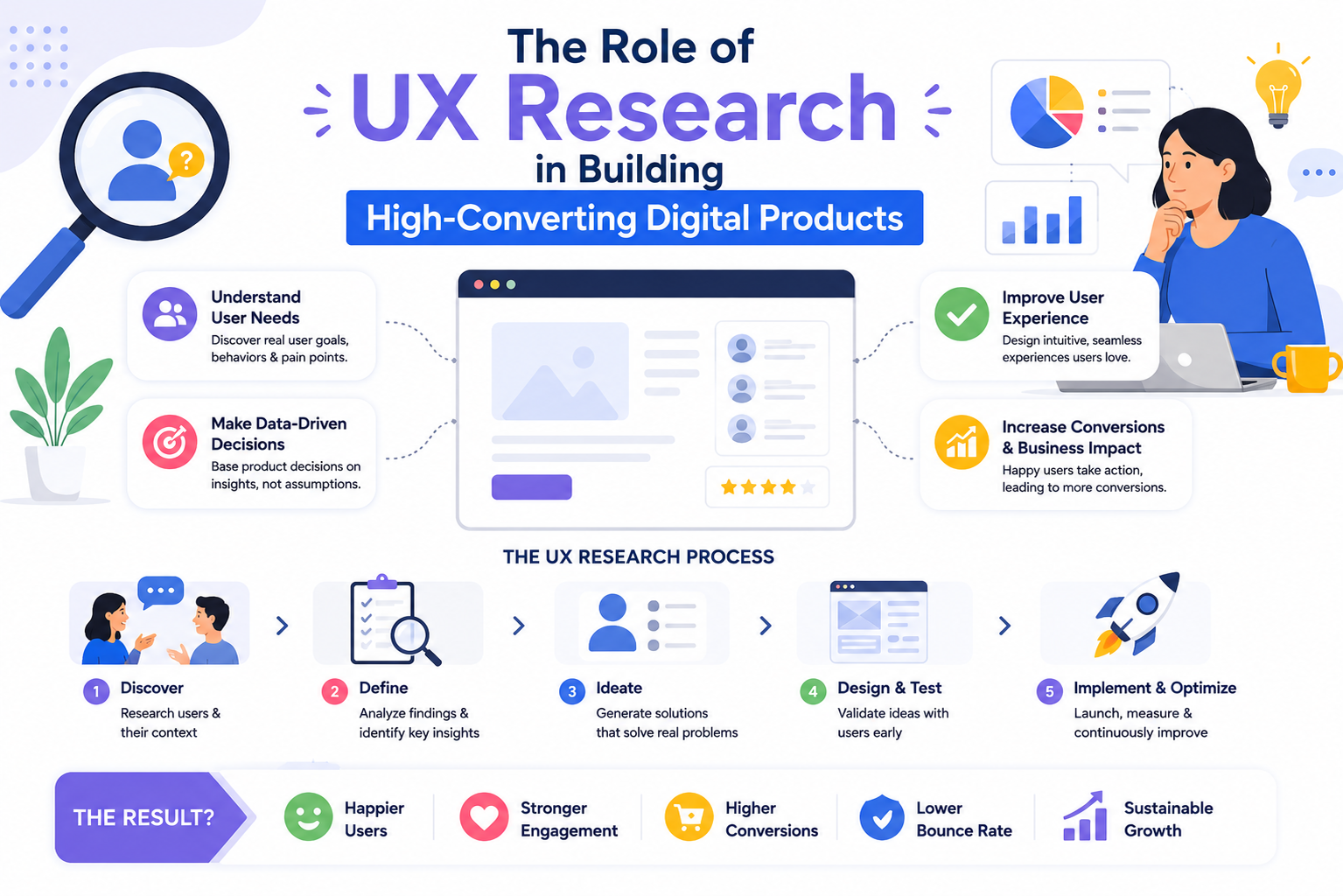
UX research is the foundation of successful digital product development. It helps businesses understand their users, identify pain points, analyze behavior patterns, and make informed design decisions. Instead of guessing what users want, UX research provides data-driven insights that guide the development process and create products people genuinely enjoy using.
Whether you’re building a website, mobile application, SaaS platform, CRM system, or e-commerce store, UX research plays a critical role in improving user satisfaction, increasing engagement, and driving conversions. Businesses that prioritize user experience often outperform competitors because they create products that solve real problems and deliver meaningful value.
This article explores the importance of UX research and how it contributes to building high-converting digital products.
What is UX Research?
UX Research is the process of studying users to understand their needs, behaviors, motivations, expectations, and challenges when interacting with a digital product. It involves gathering qualitative and quantitative data that helps designers and developers make better decisions throughout the product development lifecycle.
Rather than relying on personal opinions or assumptions, UX research focuses on real user insights. These insights help teams understand how users interact with products, what obstacles they face, and what improvements can enhance their overall experience.
The primary goal of UX research is to create products that are intuitive, efficient, user-friendly, and aligned with customer expectations.
Why UX Research Matters in Digital Product Development
Many businesses make the mistake of focusing solely on features and functionality while overlooking user behavior. A product may be technically advanced, but if users find it confusing or difficult to navigate, it is unlikely to achieve its goals.
UX research helps bridge the gap between business objectives and user expectations. It ensures that every design decision is backed by real-world data rather than assumptions.
When businesses understand their users, they can create products that are easier to use, more engaging, and more likely to convert visitors into customers.
Products built with UX research often experience lower bounce rates, higher engagement, improved customer retention, and increased conversion rates.
Understanding User Needs and Expectations
One of the most valuable aspects of UX research is its ability to uncover what users actually want.
Businesses frequently assume they understand their audience, but research often reveals unexpected behaviors and preferences. Users may interact with a product differently than anticipated, encounter obstacles that developers overlooked, or prioritize features that were initially considered less important.
By studying user behavior and gathering feedback, businesses gain a deeper understanding of customer needs and expectations.
This understanding allows teams to design experiences that feel natural, intuitive, and helpful, ultimately improving customer satisfaction and increasing the likelihood of conversion.
Reducing Assumptions and Design Risks
Developing a digital product without UX research is similar to building a house without a blueprint.
Every design decision carries some level of risk. If those decisions are based solely on assumptions, businesses may invest significant resources into features that users neither need nor value.
UX research reduces uncertainty by providing evidence-based insights. It allows teams to validate ideas before investing heavily in development and helps identify potential issues early in the design process.
This approach minimizes costly redesigns, reduces development waste, and improves the overall efficiency of product creation.
Creating User-Centered Design Experiences
Successful digital products are built around users rather than internal preferences.
UX research helps teams understand how users think, what motivates them, and how they navigate digital environments. These insights allow designers to create interfaces that align with natural user behavior.
User-centered design focuses on simplicity, accessibility, and usability. When users can easily accomplish their goals without frustration, they are more likely to engage with the product and complete desired actions.
Whether the objective is purchasing a product, filling out a form, booking a service, or subscribing to a platform, a seamless experience significantly improves conversion rates.
Improving Website and Application Usability
Usability is one of the most important factors influencing digital product success.
Even the most attractive designs can fail if users struggle to find information or complete tasks efficiently.
UX research identifies usability issues through observation, testing, and user feedback. These insights help businesses optimize navigation structures, improve content organization, simplify user flows, and eliminate friction points.
A product that is easy to use encourages users to stay longer, interact more frequently, and return in the future.
Improved usability often leads directly to better business outcomes.
Enhancing Customer Satisfaction
Customer satisfaction is closely linked to user experience.
When users can achieve their goals quickly and efficiently, they develop positive perceptions of the brand behind the product.
UX research helps businesses understand what creates satisfaction and what causes frustration. This knowledge enables teams to design experiences that exceed expectations and foster stronger customer relationships.
Satisfied users are more likely to become repeat customers, leave positive reviews, and recommend products to others.
In highly competitive markets, exceptional user experiences often become a major differentiator.
Increasing Conversion Rates Through Better Experiences
One of the primary reasons businesses invest in UX research is its impact on conversion optimization.
Conversions occur when users complete desired actions such as making a purchase, submitting a contact form, signing up for a newsletter, or requesting a consultation.
UX research helps identify barriers that prevent users from converting. These barriers may include confusing navigation, unclear messaging, complex checkout processes, or poor information architecture.
By removing obstacles and optimizing user journeys, businesses can create smoother experiences that encourage action.
Even small improvements in user experience can produce significant increases in conversion rates.
Supporting Data-Driven Decision Making
Modern businesses rely on data to make strategic decisions, and UX research plays a vital role in this process.
Research provides valuable insights into user behavior, preferences, and pain points. These insights help teams prioritize features, improve interfaces, and allocate resources more effectively.
Instead of relying on personal opinions, stakeholders can make decisions based on evidence and measurable outcomes.
Data-driven decision making leads to more successful products and reduces the likelihood of costly mistakes.
Strengthening Brand Trust and Loyalty
Trust is a critical factor in digital product success.
Users are more likely to trust businesses that provide smooth, reliable, and user-friendly experiences.
Poor design, confusing interfaces, and frustrating interactions can quickly damage credibility and drive users toward competitors.
UX research helps businesses understand what builds trust and how users perceive their brand throughout the customer journey.
When users consistently enjoy positive experiences, they are more likely to develop loyalty and maintain long-term relationships with the brand.
The Relationship Between UX Research and Business Growth
UX research is often viewed as a design activity, but its impact extends far beyond aesthetics.
Improved user experiences contribute directly to business growth by increasing customer satisfaction, improving retention rates, reducing support costs, and driving more conversions.
Businesses that invest in UX research often discover opportunities to enhance efficiency, streamline processes, and create products that better serve market demands.
Over time, these improvements lead to stronger customer relationships and increased revenue.
UX research is not simply an expense—it is a strategic investment in long-term business success.
Common Mistakes Businesses Make Without UX Research
Many digital products fail because businesses skip the research phase and rely entirely on assumptions.
Without UX research, organizations often create products that prioritize internal preferences over user needs. This can result in confusing interfaces, unnecessary features, poor navigation structures, and low engagement.
Businesses may spend months developing functionality that users rarely use while overlooking the features customers actually need.
Research helps prevent these mistakes by ensuring that product decisions are aligned with real-world user behavior.
The Future of UX Research in Digital Product Development
As digital experiences become increasingly sophisticated, UX research will continue to play a critical role in product success.
Advancements in analytics, artificial intelligence, user testing platforms, and behavioral tracking tools are providing businesses with deeper insights into customer behavior than ever before.
Organizations that embrace UX research as an ongoing process rather than a one-time activity will be better positioned to adapt to changing user expectations and market conditions.
The future belongs to businesses that prioritize customer needs and continuously improve their digital experiences.
Conclusion
UX research is one of the most valuable investments a business can make when developing digital products. It provides a deep understanding of user behavior, reduces design risks, improves usability, and helps create experiences that align with customer expectations.
By placing users at the center of the design process, businesses can build websites, applications, and software solutions that not only look great but also perform exceptionally well. Better user experiences lead to higher engagement, stronger customer satisfaction, increased trust, and improved conversion rates.
In a digital world where users have countless options, understanding your audience is no longer optional. UX research provides the insights needed to create high-converting digital products that deliver value to both customers and businesses alike.
A wonderful serenity has taken possession of my entire soul, like these sweet mornings of spring which I enjoy with my whole heart. I am alone, and feel the charm of existence in this spot, which was created for the bliss of souls like mine. I am so happy.
my dear friend, so absorbed in the exquisite sense of mere tranquil existence, that I neglect my talents.
I feel that I never was a greater artist than now. When, while the lovely valley teems with vapour around me, and the meridian sun strikes the upper surface of the impenetrable foliage of my trees, and but a few stray gleams steal into the inner sanctuary.