

Introduction
A business website is often the first interaction potential customers have with a brand. Within seconds, visitors form opinions about a company based on the design, usability, performance, and overall experience of its website. In today’s competitive digital landscape, having an attractive website is no longer enough. Businesses need websites that are intuitive, accessible, engaging, and designed around user needs.
A user-friendly website not only improves customer satisfaction but also increases engagement, generates more leads, boosts conversions, and strengthens brand credibility. Visitors expect websites to be fast, easy to navigate, and capable of helping them find information quickly. If a website creates confusion or frustration, users are likely to leave and choose a competitor instead.
This article explores the best practices for designing user-friendly business websites that deliver exceptional user experiences and support long-term business growth.
Understanding the Importance of User-Friendly Website Design
Website design is about much more than aesthetics. While visual appeal plays an important role, usability ultimately determines whether visitors stay on a website or leave.
A user-friendly website helps visitors accomplish their goals efficiently. Whether users want to learn about services, request a quote, make a purchase, or contact a business, the experience should feel simple and intuitive.
When visitors can easily navigate a website and find relevant information without difficulty, they are more likely to engage with the brand and take desired actions. This directly contributes to higher conversion rates and stronger customer relationships.
Businesses that prioritize user experience often gain a significant competitive advantage because they make it easier for customers to interact with their products and services.
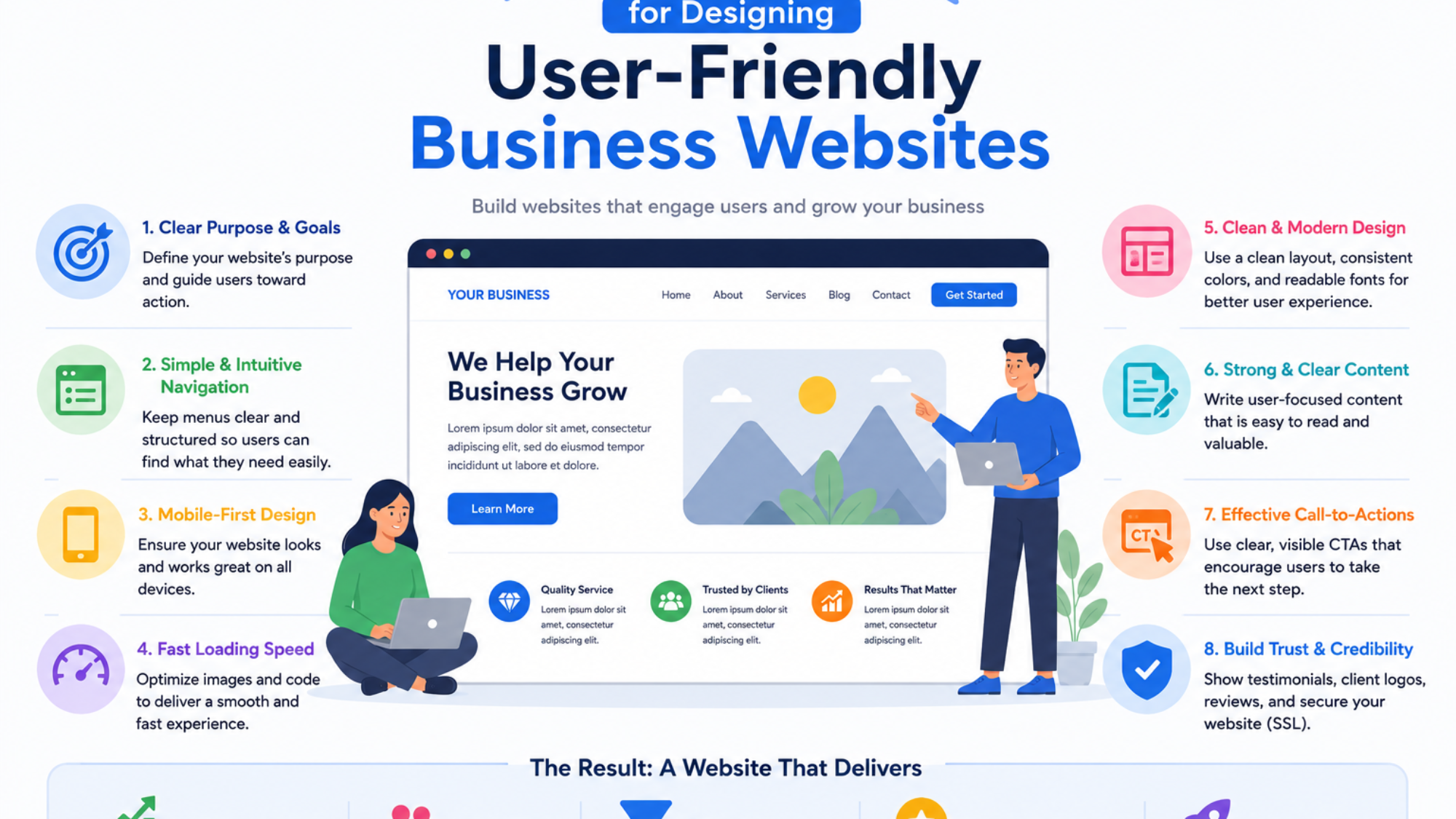
Prioritize Simplicity in Design
One of the most effective principles of user-friendly web design is simplicity.
Many businesses attempt to include excessive visual elements, animations, colors, and content on a single page. While these features may seem appealing, they often overwhelm visitors and distract them from important information.
A clean and organized design allows users to focus on the content that matters most. Simple layouts improve readability, reduce confusion, and create a more professional appearance.
Effective design removes unnecessary distractions and guides visitors naturally toward their goals.
The most successful websites often achieve their results not because they include more elements, but because they include only what is necessary.
Create Clear and Intuitive Navigation
Navigation is one of the most important aspects of website usability.
Visitors should never have to guess where to find information. A well-structured navigation system helps users explore a website efficiently and understand its content hierarchy.
Menus should be straightforward, organized logically, and easy to access on both desktop and mobile devices. Important pages such as services, about, contact, pricing, and portfolio sections should be clearly visible.
When navigation is intuitive, users spend less time searching and more time engaging with the content.
Poor navigation, on the other hand, often leads to frustration and increased bounce rates.
Design for Mobile Users First
Mobile devices now account for a significant portion of website traffic across most industries. As a result, businesses must prioritize mobile responsiveness when designing their websites.
A mobile-friendly website automatically adapts to different screen sizes while maintaining usability and readability.
Visitors should be able to navigate menus, read content, click buttons, and complete actions comfortably on smartphones and tablets.
Mobile-first design not only improves user experience but also supports better search engine rankings since Google prioritizes mobile-friendly websites through its mobile-first indexing approach.
Ignoring mobile optimization can negatively impact both traffic and conversions.
Improve Website Loading Speed
Website performance has a direct impact on user satisfaction.
Modern users expect websites to load almost instantly. Even small delays can lead to increased abandonment rates and lost business opportunities.
Slow-loading websites create frustration and reduce trust in a brand’s professionalism.
Optimizing images, reducing unnecessary scripts, implementing caching, and using reliable hosting solutions can significantly improve performance.
Fast websites create smoother user experiences and encourage visitors to remain engaged for longer periods.
Performance optimization is one of the simplest ways to improve both usability and conversion rates.
Focus on Readable and Well-Structured Content
Content remains one of the most important elements of any business website.
Even the best design cannot compensate for poorly organized or difficult-to-read content.
Visitors should be able to scan pages quickly and understand key information without effort. Clear headings, logical content structure, appropriate spacing, and concise language all contribute to better readability.
Well-written content helps users find answers faster and increases confidence in the business.
When content is easy to consume, visitors are more likely to continue exploring the website and engage with the brand.
Use Strong Visual Hierarchy
Visual hierarchy guides users through a page and helps them identify the most important information.
Effective hierarchy uses size, spacing, contrast, and positioning to direct attention toward key elements.
Important messages, headlines, calls-to-action, and conversion points should stand out clearly without overwhelming the design.
When visual hierarchy is implemented effectively, users naturally understand where to focus and what actions they should take next.
This creates a smoother browsing experience and supports better conversion performance.
Build Trust Through Professional Design
Trust plays a major role in online decision-making.
Visitors often evaluate a company’s credibility based on its website design. A poorly designed website can create doubts about the quality of products or services being offered.
Professional design communicates reliability, competence, and attention to detail.
Elements such as customer testimonials, case studies, client logos, certifications, secure browsing indicators, and clear contact information help reinforce trust.
A trustworthy website makes visitors feel confident about engaging with a business.
Make Calls-to-Action Clear and Visible
Every business website should guide visitors toward specific actions.
Whether the goal is generating leads, scheduling consultations, requesting quotes, or making purchases, users need clear direction.
Calls-to-action should be easy to identify and strategically placed throughout the website.
Visitors should immediately understand what action they can take and why it benefits them.
When calls-to-action are visible, relevant, and compelling, conversion rates often improve significantly.
Ensure Accessibility for All Users
Accessibility is an essential component of user-friendly design.
Websites should be usable by individuals with different abilities, devices, and browsing conditions.
Accessible design includes readable text, sufficient color contrast, keyboard navigation support, descriptive image alternatives, and clear content structure.
By making websites accessible, businesses can reach a wider audience while demonstrating inclusivity and professionalism.
Accessibility improvements often enhance usability for all visitors, not just those with specific needs.
Maintain Consistent Branding
Consistency creates familiarity and trust.
A business website should maintain a unified visual identity across all pages. Colors, typography, imagery, messaging, and design elements should work together to create a cohesive brand experience.
Consistent branding strengthens recognition and helps visitors remember the business.
When users encounter a consistent experience, they are more likely to perceive the company as reliable and professional.
Strong branding contributes significantly to long-term customer trust and loyalty.
Continuously Test and Improve User Experience
User-friendly design is not a one-time achievement. User expectations, technology, and business goals constantly evolve.
Successful businesses regularly analyze website performance, monitor user behavior, gather feedback, and identify areas for improvement.
Ongoing optimization helps businesses adapt to changing customer needs while maintaining competitive advantages.
Continuous improvement ensures that websites remain effective, relevant, and aligned with user expectations over time.
The most successful websites are those that evolve based on real user insights rather than assumptions.
The Connection Between User Experience and Business Growth
A user-friendly website contributes directly to business success.
When visitors can easily navigate a website, find information, and complete actions, they are more likely to become customers.
Positive experiences lead to stronger engagement, improved satisfaction, increased trust, and higher conversion rates.
Businesses that invest in user-centered design often experience better marketing performance, improved customer retention, and stronger online visibility.
User experience is no longer just a design consideration—it has become a critical business strategy.
Conclusion
Designing a user-friendly business website requires a thoughtful balance between aesthetics, functionality, performance, and usability. While visual appeal helps create positive first impressions, the true success of a website depends on how effectively it serves its users.
By prioritizing simplicity, intuitive navigation, mobile responsiveness, fast loading speeds, readable content, accessibility, and trust-building elements, businesses can create digital experiences that attract, engage, and convert visitors.
In an increasingly competitive online environment, companies that focus on delivering exceptional user experiences are better positioned to build stronger customer relationships and achieve sustainable growth. A user-friendly website is not simply a digital asset—it is one of the most valuable tools a business can use to support long-term success.
A wonderful serenity has taken possession of my entire soul, like these sweet mornings of spring which I enjoy with my whole heart. I am alone, and feel the charm of existence in this spot, which was created for the bliss of souls like mine. I am so happy.
my dear friend, so absorbed in the exquisite sense of mere tranquil existence, that I neglect my talents.
I feel that I never was a greater artist than now. When, while the lovely valley teems with vapour around me, and the meridian sun strikes the upper surface of the impenetrable foliage of my trees, and but a few stray gleams steal into the inner sanctuary.