

Introduction
A website is one of the most important digital assets for any modern business. Whether you’re launching a startup, growing an established company, or expanding your online presence, the type of website you choose can significantly impact your brand, user experience, and long-term growth.
One of the most common decisions businesses face is whether to invest in a custom-developed website or use a pre-designed template-based solution. Both options have advantages and limitations, and the right choice depends on your business goals, budget, scalability requirements, and desired functionality.
While template-based websites offer a quick and affordable way to get online, custom web development provides flexibility, uniqueness, and long-term scalability. Understanding the differences between these approaches can help businesses make informed decisions that align with their future growth plans.
This article explores custom web development and template-based websites in detail, comparing their benefits, limitations, and suitability for different types of businesses.
Understanding Custom Web Development
Custom web development involves building a website from the ground up based on specific business requirements.
Instead of relying on pre-built layouts and limited functionality, custom websites are designed and developed according to a company’s unique goals, branding, workflows, and customer expectations.
Every aspect of the website, including design, functionality, user experience, integrations, and performance optimization, is tailored specifically to the business.
Custom development allows businesses to create digital experiences that perfectly align with their objectives while maintaining complete control over the website’s structure and capabilities.
Understanding Template-Based Websites
Template-based websites use pre-designed layouts and frameworks that can be customized to some extent.
These templates are commonly available through platforms such as WordPress, Shopify, Wix, Squarespace, and other website builders.
Businesses can modify colors, images, text, and certain design elements without needing extensive development work.
Template-based solutions provide a faster and more affordable route to launching a website, making them attractive for startups, small businesses, and individuals with limited budgets.
However, templates often come with design and functionality limitations that may become restrictive as business requirements evolve.
Design Flexibility and Brand Identity
One of the biggest differences between custom development and template-based websites is design flexibility.
Custom web development allows businesses to create a completely unique online presence. Every design element can be tailored to match brand identity, customer expectations, and business objectives.
A custom-designed website helps businesses stand out from competitors and create memorable user experiences that strengthen brand recognition.
Template-based websites, on the other hand, are built using pre-existing designs that may also be used by thousands of other businesses. While customization options exist, achieving complete uniqueness can be difficult.
For businesses that prioritize branding and differentiation, custom development often provides a significant advantage.
User Experience and Customer Engagement
User experience plays a critical role in determining how visitors interact with a website.
Custom websites are built with specific user journeys in mind. Developers and designers can create navigation structures, interfaces, and interactions that align perfectly with customer needs.
This level of personalization often leads to improved engagement, lower bounce rates, and higher conversion rates.
Template-based websites generally follow standard design patterns intended to serve a wide range of users. While these templates may offer acceptable usability, they are not specifically optimized for individual business goals.
As a result, businesses may miss opportunities to create more effective customer experiences.
Performance and Website Speed
Website speed is an important factor for both user experience and search engine rankings.
Custom-developed websites are typically built with only the features and code necessary for the business. This streamlined approach often results in faster loading times and better overall performance.
Developers can optimize every aspect of the website to ensure maximum efficiency.
Template-based websites frequently include numerous built-in features designed to accommodate different users. Many of these features may never be used, yet they still contribute to increased page weight and slower performance.
While optimization is possible, templates often carry limitations that can affect speed and responsiveness.
Scalability and Future Growth
As businesses grow, their digital requirements often become more complex.
Custom web development is designed with scalability in mind. Businesses can add new features, integrate third-party systems, expand functionality, and adapt to changing market demands without major restrictions.
Whether adding customer portals, CRM integrations, advanced e-commerce features, or custom workflows, custom websites provide the flexibility needed for long-term growth.
Template-based websites may work well initially, but scalability can become a challenge as business needs evolve. Certain features may require extensive modifications, and some functionality may be impossible to implement within the template’s framework.
Businesses planning for future expansion often benefit from the flexibility of custom development.
Search Engine Optimization (SEO)
Search engine visibility is essential for attracting organic traffic and generating leads.
Custom websites provide greater control over technical SEO elements, site structure, page speed, schema markup, URL architecture, and optimization strategies.
Developers can build websites specifically to support search engine performance from the ground up.
Template-based websites can also be optimized for SEO, but limitations in coding structure, plugin dependencies, and performance may affect results.
For businesses competing in highly competitive markets, custom development often provides stronger SEO opportunities and long-term advantages.
Security and Reliability
Website security is increasingly important as businesses collect customer information and process online transactions.
Custom-developed websites can implement security measures tailored to specific business requirements. Developers can minimize vulnerabilities by avoiding unnecessary third-party dependencies and maintaining full control over the codebase.
Template-based websites often rely heavily on plugins, themes, and third-party extensions. While many are secure, outdated components can create security risks if not properly maintained.
Businesses handling sensitive customer data may find custom development provides greater security and control.
Development Time and Initial Investment
One area where template-based websites often have an advantage is speed and affordability.
Businesses can launch template-based websites relatively quickly because much of the design and development work has already been completed.
This makes templates an attractive option for startups or businesses with limited budgets.
Custom web development requires more planning, design work, development effort, and testing. As a result, it generally involves higher upfront costs and longer project timelines.
However, the additional investment often delivers greater long-term value through improved performance, flexibility, and scalability.
Maintenance and Long-Term Costs
While template-based websites may appear less expensive initially, long-term costs can sometimes increase as businesses require additional functionality, premium plugins, customization work, and ongoing maintenance.
Custom websites typically require professional maintenance but often provide greater stability and fewer compatibility issues over time.
Businesses should evaluate both short-term and long-term costs when choosing between custom development and template solutions.
What appears affordable today may become costly if significant modifications are needed in the future.
Which Option is Best for Small Businesses?
For small businesses that need a simple online presence with basic functionality, a template-based website may be sufficient.
Businesses such as local service providers, personal brands, freelancers, and small retailers often benefit from the affordability and speed of template solutions.
However, businesses with ambitious growth plans, unique service offerings, specialized workflows, or strong branding requirements may quickly outgrow template limitations.
In these situations, investing in custom web development can provide a stronger foundation for future success.
Which Option is Best for Growing Businesses and Enterprises?
Growing businesses typically require greater flexibility, scalability, and integration capabilities.
Custom web development allows organizations to create solutions that support complex workflows, advanced functionality, customer portals, business automation, and evolving operational requirements.
For companies that view their website as a critical business asset rather than simply an online brochure, custom development is often the preferred choice.
The ability to adapt and scale becomes increasingly valuable as businesses expand.
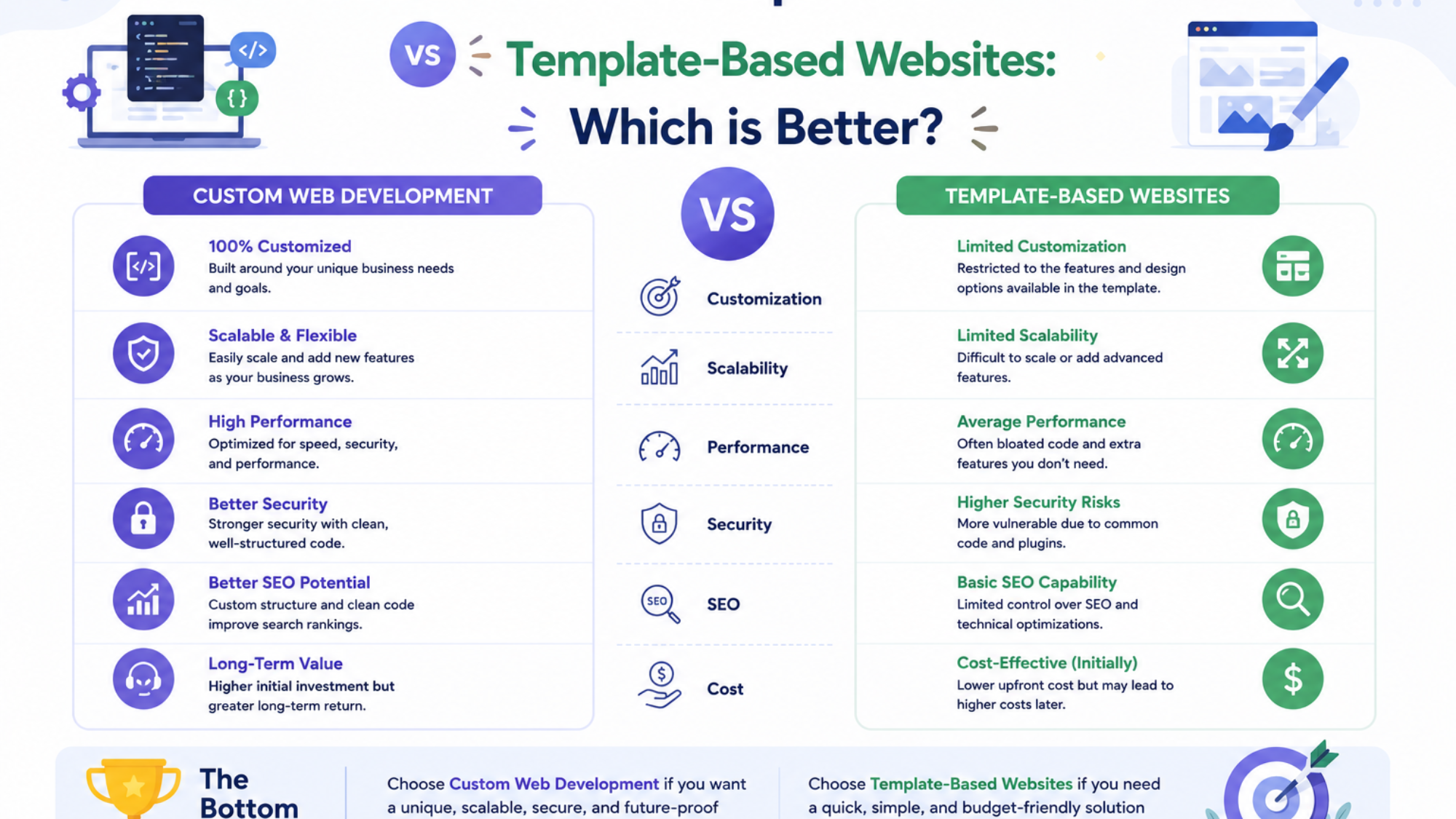
Custom Web Development vs Template-Based Websites: Final Comparison
Custom web development offers unmatched flexibility, scalability, performance, and branding opportunities. It allows businesses to create unique digital experiences tailored to their goals while supporting future growth and innovation.
Template-based websites provide a faster and more affordable way to establish an online presence. They work well for businesses with limited budgets and straightforward requirements but may become restrictive as needs evolve.
The best choice depends on your business objectives, growth plans, budget, and long-term vision.
If your goal is simply to launch a basic website quickly, a template-based solution may be sufficient. However, if you want a website that serves as a powerful business tool capable of supporting growth, improving customer experiences, and differentiating your brand, custom web development often delivers greater value.
Conclusion
Choosing between custom web development and template-based websites is one of the most important decisions a business can make when building its online presence. Both approaches offer unique benefits, but they serve different purposes and business needs.
Template-based websites provide affordability and speed, making them ideal for businesses seeking a simple online presence. Custom web development, on the other hand, offers complete flexibility, stronger performance, enhanced security, better scalability, and a truly unique user experience.
For businesses focused on long-term growth, customer engagement, and competitive advantage, custom web development often proves to be the more strategic investment. While it may require greater upfront resources, the ability to adapt, scale, and create exceptional digital experiences can deliver significant returns over time.
Ultimately, the right choice depends on where your business is today and where you want it to be in the future.
Add a Comment